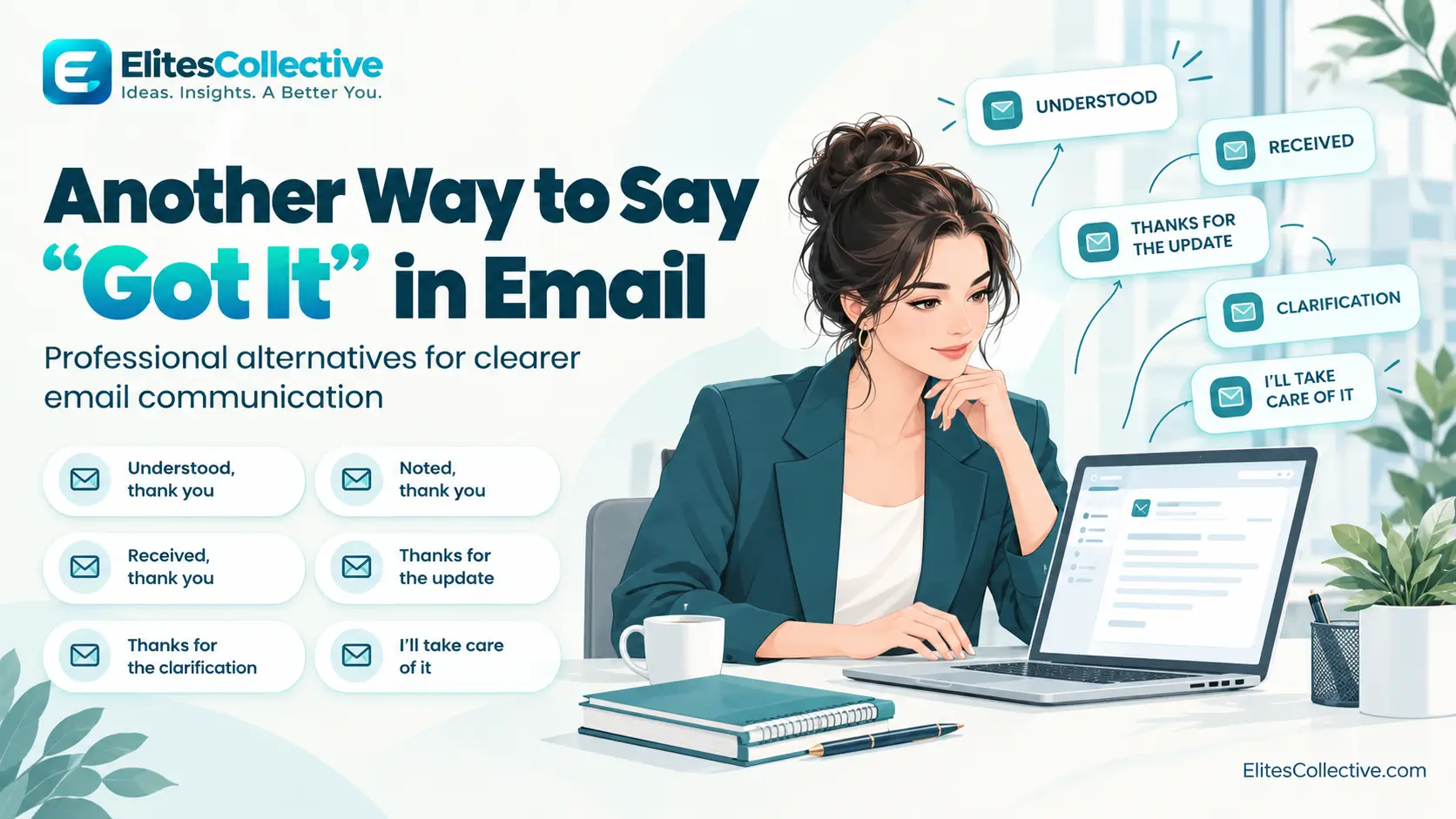
If you want another way to say “got it” in an email, good options include “Understood, thank you,” “I understand,” “Noted, thank you,” “Thanks for letting me know,” “Received, thank you,” and “Thanks for the clarification.” The best choice depends on whether you are confirming understanding, acknowledging receipt, responding to an update, or agreeing to take action.
Key Takeaways
- “Understood, thank you” is a clear professional alternative when you understand instructions or information.
- “Noted, thank you” works well for acknowledging updates, deadlines, or instructions.
- “Received, thank you” is more specific when your main goal is to confirm that you received a document or message.
- “Thanks for letting me know” sounds natural when someone has shared an update or change.
- “Thanks for the clarification” is appropriate when someone’s explanation helped resolve confusion.
- If you need to confirm that you will do something, include the action rather than simply saying “got it.”
What Does “Got It” Mean in an Email?
In email communication, “got it” can mean several slightly different things. Most often, it tells the sender that you understand what they said or have received the information.
For example:
Please send the revised proposal by Friday.
Got it, thank you.
Here, “got it” mainly confirms that the instruction was understood.
But the same phrase can have a different meaning:
I’ve attached the updated contract for your review.
Got it, thank you.
In this case, the response may primarily confirm receipt of the attachment.
That distinction matters because a more specific response can make your email clearer and more professional.
Best Alternatives to “Got It” in an Email
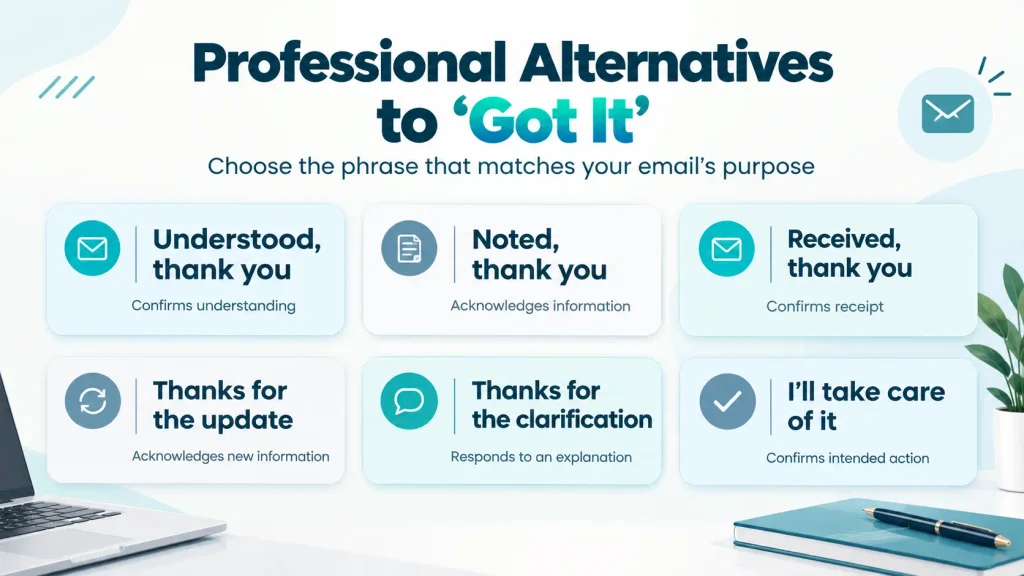
1. Understood, Thank You
“Understood, thank you” is one of the closest professional alternatives to “got it.”
It works especially well when someone gives you instructions, explains a process, or tells you what needs to happen next.
Example:
Understood, thank you. I’ll make the requested changes before the meeting.
Best for: Instructions, work requests, professional emails
2. I Understand, Thank You
“I understand, thank you” sounds slightly warmer and more conversational than simply saying “Understood.”
Use it when you want to confirm that you understand an explanation, decision, or request.
Example:
I understand, thank you for explaining the changes to the project timeline.
Best for: Explanations, clarification, workplace communication
3. Noted, Thank You
“Noted, thank you” confirms that you have taken the information into account.
It is particularly useful for deadlines, schedule changes, instructions, reminders, and other details you need to remember.
Example:
Noted, thank you. I’ll use the updated deadline in the project schedule.
Best for: Updates, deadlines, instructions, reminders
Usage tip: “Noted” can sound somewhat brief or formal when used by itself. Adding “thank you” or a next step can make the reply warmer.
4. Thanks for Letting Me Know
This is a natural choice when someone has given you new information.
It does not necessarily mean that you agree with the information. It simply acknowledges that you received the update.
Example:
Thanks for letting me know. I’ll adjust my schedule accordingly.
Best for: Updates, schedule changes, announcements, notifications
5. Thanks for the Update
Use this when the sender has provided new information about a project, meeting, task, order, or other situation.
Example:
Thanks for the update. I’ll review the latest version this afternoon.
Best for: Project updates, status reports, workplace emails
6. Thanks for the Clarification
This phrase is better than “got it” when someone has explained something that was unclear.
It specifically shows that their explanation helped you understand the issue.
Example:
Thanks for the clarification. I understand which version needs to be submitted now.
Best for: Questions, corrections, explanations, misunderstandings
7. Received, Thank You
“Received, thank you” is useful when your main purpose is to confirm that something reached you.
It works particularly well when someone sends an attachment, document, file, or other material.
Example:
Received, thank you. I’ll review the document and follow up if I have any questions.
Best for: Documents, attachments, files, requested information
Important: “Received” confirms delivery, but it does not necessarily confirm that you have understood or approved the contents.
8. Thanks, I’ll Keep That in Mind
This is useful when someone gives you advice, a preference, a reminder, or information that may affect something you do later.
Example:
Thanks, I’ll keep that in mind when I prepare the next draft.
Best for: Advice, preferences, suggestions, reminders
9. That Makes Sense, Thank You
“That makes sense” tells the sender that their explanation is logical or clear to you.
It is a warmer alternative when the conversation involves explaining a decision or solving confusion.
Example:
That makes sense, thank you. I can see why the deadline was moved.
Best for: Explanations, decisions, problem-solving
10. I’ll Take Care of It
Use this when “got it” is really intended to mean “I understand what needs to be done, and I will handle it.”
It is more action-oriented than simply acknowledging the message.
Example:
I’ll take care of it and send you the revised file by Thursday.
Best for: Assigned tasks, requests, action items
Usage tip: Only use this when you are actually taking responsibility for the task. It communicates more than simple understanding.
Which Alternative Should You Use?
The best replacement depends on what you want your email to communicate.
| What you mean | Natural alternative | Tone | Best context |
|---|---|---|---|
| I understand | Understood, thank you | Professional | Instructions |
| I understand your explanation | I understand, thank you | Polite | Explanations |
| I have taken note of this | Noted, thank you | Professional | Updates and reminders |
| I received your information | Thanks for letting me know | Friendly, professional | General updates |
| I received an update | Thanks for the update | Professional | Work communication |
| Your explanation helped | Thanks for the clarification | Polite | Questions or confusion |
| I received the file | Received, thank you | Professional | Documents and attachments |
| I will remember this | I’ll keep that in mind | Warm | Advice or suggestions |
| Your explanation is clear | That makes sense, thank you | Warm | Explanations |
| I will handle the task | I’ll take care of it | Direct, professional | Action items |
“Got It” vs. “Understood” in an Email
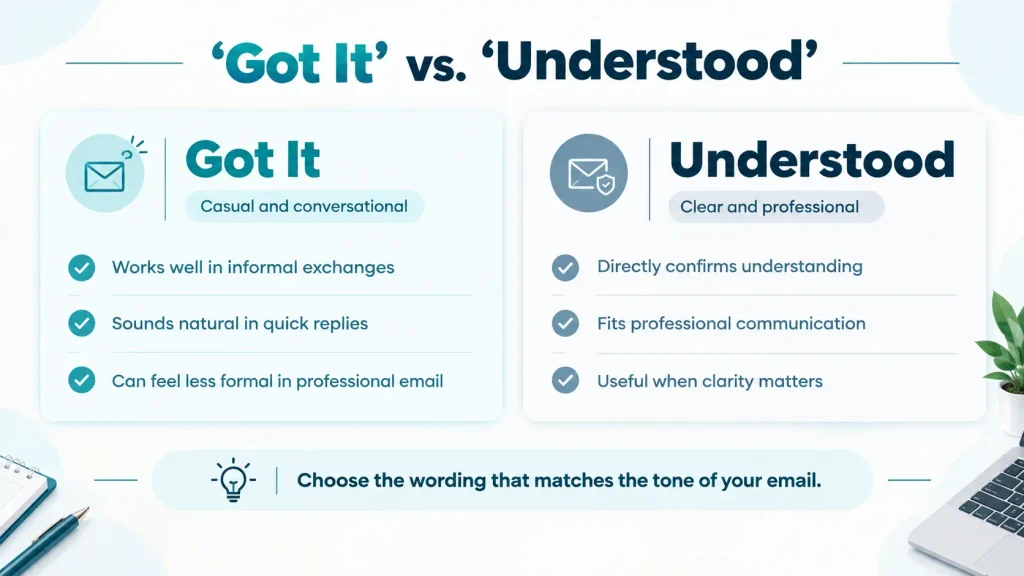
“Got it” and “understood” are close in meaning, but they do not always create the same impression.
“Got it” is conversational and works naturally with coworkers or people you communicate with regularly. It can also be perfectly acceptable in informal professional emails.
“Understood” sounds more deliberate and professional. It is especially useful when responding to instructions or an important request.
Compare these examples:
Got it. I’ll update the document.
Understood. I’ll update the document.
Both are clear. The second simply has a more formal tone.
For an email to a client, manager, or unfamiliar professional contact, “Understood, thank you” may fit better when you want a polished acknowledgment.
“Noted” vs. “Received” vs. “Understood”
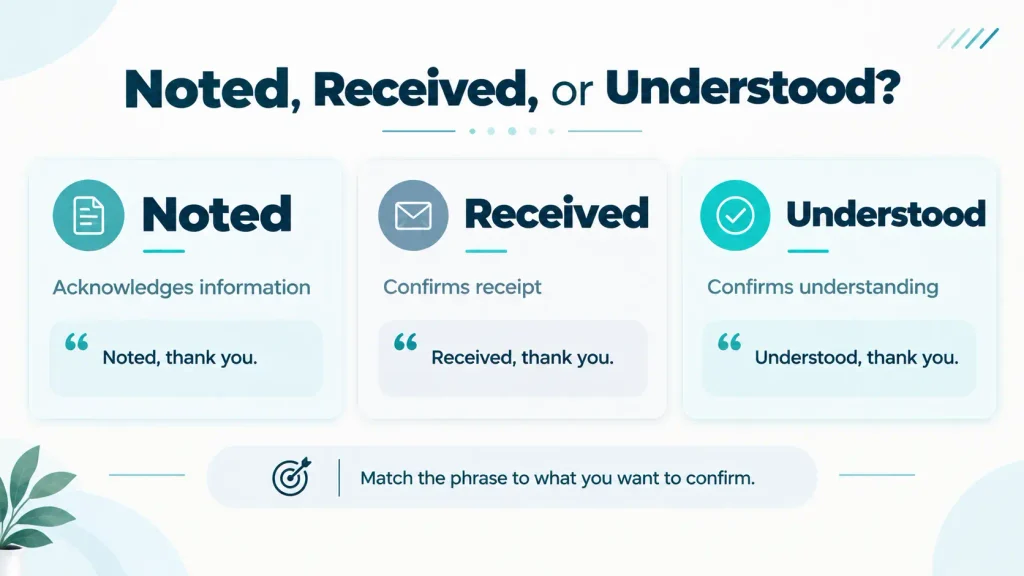
These three phrases are often used interchangeably, but they communicate different things.
Noted
Noted means you have taken notice of the information and will keep it in mind.
Noted, thank you. I’ll use the new meeting time.
Received
Received focuses on getting the message, file, or document.
Received, thank you. I’ll review the attachment.
Understood
Understood focuses on comprehension.
Understood, thank you. I’ll follow the revised instructions.
If you want to be especially clear, combine the acknowledgment with the next step:
Received, thank you. I’ll review the document and send my feedback tomorrow.
That tells the sender both that the file arrived and what you plan to do with it.
Professional Email Examples
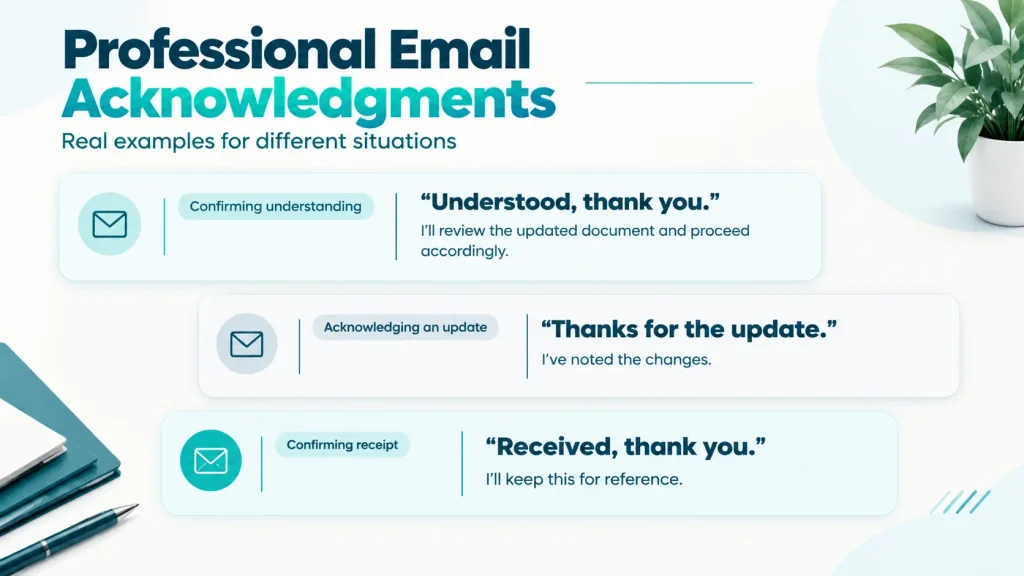
When Your Manager Gives You an Instruction
Instead of:
Got it, thanks.
Try:
Understood, thank you. I’ll make the changes before the deadline.
This is useful because it confirms both understanding and action.
When a Client Sends an Update
Instead of:
Got it.
Try:
Thanks for the update. I’ll keep this in mind as I move forward.
This sounds appreciative without implying that you agree with every detail.
When Someone Explains a Problem
Instead of:
Got it, thank you.
Try:
Thanks for the clarification. That makes sense now.
This directly responds to the explanation.
When Someone Sends an Attachment
Instead of:
Got it.
Try:
Received, thank you. I’ll review the attachment and get back to you.
This is clearer because it confirms receipt of the document.
When You Agree to Complete a Task
Instead of:
Got it, I’ll do it.
Try:
Understood. I’ll take care of it and follow up once it’s complete.
This communicates both understanding and responsibility.
Is “Got It” Professional in an Email?
Yes. “Got it” is not inherently unprofessional. It is a normal conversational expression, and it can work well in emails with coworkers, teammates, clients you know well, or other people with whom you have an informal communication style.
The issue is usually context rather than correctness.
For a formal or sensitive message, a more specific response may be preferable. For example, “Received, thank you” is clearer when confirming a document, while “Understood, thank you” is clearer when acknowledging instructions.
You do not need to avoid “got it” completely. Instead, choose the wording that accurately communicates what you mean.
Common Mistakes to Avoid
Using “Noted” When You Need to Confirm Understanding
“Noted” mainly communicates that you have taken notice of something. If the sender explained a complicated issue and you want to confirm comprehension, “I understand” or “Thanks for the clarification” may be clearer.
Using “Received” to Show Agreement
“Received” confirms that you got the information. It does not necessarily mean that you agree with it.
For example:
Received, thank you.
does not automatically mean:
I agree with your proposal.
If agreement matters, say so directly.
Saying “Understood” When You Have Not Actually Understood
A short acknowledgment should not replace a necessary question.
If an instruction is unclear, it is better to write:
Thanks for the information. Could you clarify which version you would like me to use?
That is more useful than simply saying “Understood” when you still need clarification.
Overusing “Acknowledged”
“Acknowledged” is grammatically correct, but it can sound formal, procedural, or impersonal in an ordinary workplace email.
For a routine message, “Thanks for the update” or “Understood, thank you” may sound more natural.
Confirming Receipt Without Mentioning the Next Step
If the sender needs to know what happens next, a simple acknowledgment may not be enough.
Instead of:
Received, thank you.
you can write:
Received, thank you. I’ll review it and send my feedback by Friday.
The second version reduces uncertainty and makes the response more useful.
How to Choose the Right Phrase
A simple way to choose is to ask yourself what you are actually confirming:
- Understanding? Use “Understood” or “I understand.”
- Receipt? Use “Received, thank you.”
- An update? Use “Thanks for the update.”
- New information? Use “Thanks for letting me know.”
- An explanation? Use “Thanks for the clarification.”
- A suggestion or reminder? Use “I’ll keep that in mind.”
- An assigned task? Use “I’ll take care of it.”
- A clear explanation? Use “That makes sense, thank you.”
This approach is more precise than replacing “got it” with the same phrase every time.
FAQs About Another Way to Say Got It in Email
What is a professional way to say “got it” in an email?
“Understood, thank you” is a natural professional option. “I understand” also works well when you want to sound slightly warmer. For a document or attachment, “Received, thank you” is more precise.
What is a polite way to say “got it” in an email?
Try “Thanks for letting me know,” “I understand, thank you,” or “Thanks for the clarification.” The best choice depends on whether you received an update, understood an explanation, or are acknowledging instructions.
Is “got it” too casual for a professional email?
Not necessarily. “Got it” is common in everyday workplace communication, especially with coworkers and familiar contacts. For formal correspondence, a more specific phrase such as “Understood, thank you” can create a more polished tone.
Can I say “noted, thank you” in an email?
Yes. “Noted, thank you” is useful when you want to acknowledge information, instructions, deadlines, or an update. It focuses more on taking note of something than on simply receiving a message.
What should I say when I receive an attachment?
“Received, thank you” is a concise option. You can make it more helpful by adding what you will do next:
Received, thank you. I’ll review the attachment and follow up tomorrow.
What should I say instead of “got it” when I agree?
If you are actually agreeing with a proposal or plan, say so directly. For example, “That works for me,” “Sounds good,” or “I’m happy to proceed” communicates agreement more clearly than “got it.”
How do I confirm that I understand an email?
Use a phrase such as “Understood, thank you” or “I understand.” If there is an action involved, add it:
Understood, thank you. I’ll send the revised version by Friday.
Final Thoughts
There is no single replacement for “got it” that works in every email. The most natural choice depends on what you are actually trying to communicate.
Use “Understood, thank you” for instructions, “Received, thank you” for documents or messages, “Thanks for the update” for new information, and “Thanks for the clarification” when an explanation resolves confusion. When a task requires action, state the action directly.
Choosing a phrase based on its meaning—not simply its level of formality—makes your emails clearer, more natural, and more useful.

Role: English Language & Communication Writer
Daniel Carter is an English language writer specializing in workplace communication, professional vocabulary, resumes, emails, and career-focused English.