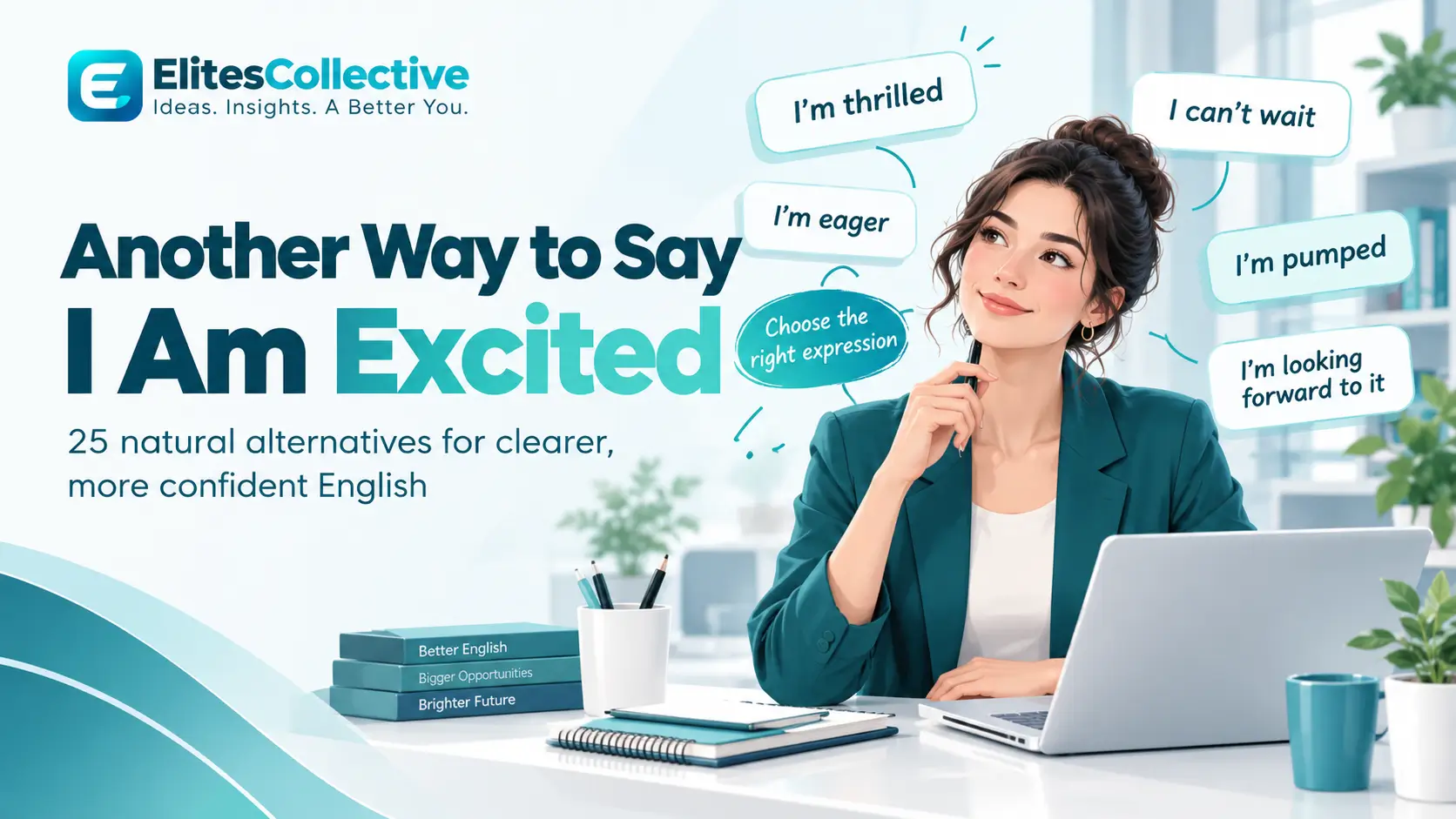
If you need another way to say “I am excited,” you have many natural choices. You can say “I’m thrilled,” “I can’t wait,” “I’m eager,” “I’m looking forward to it,” or “I’m so happy about this.” Your best choice depends on the situation, your tone, and how strongly you want to express your excitement.
Key Takeaways
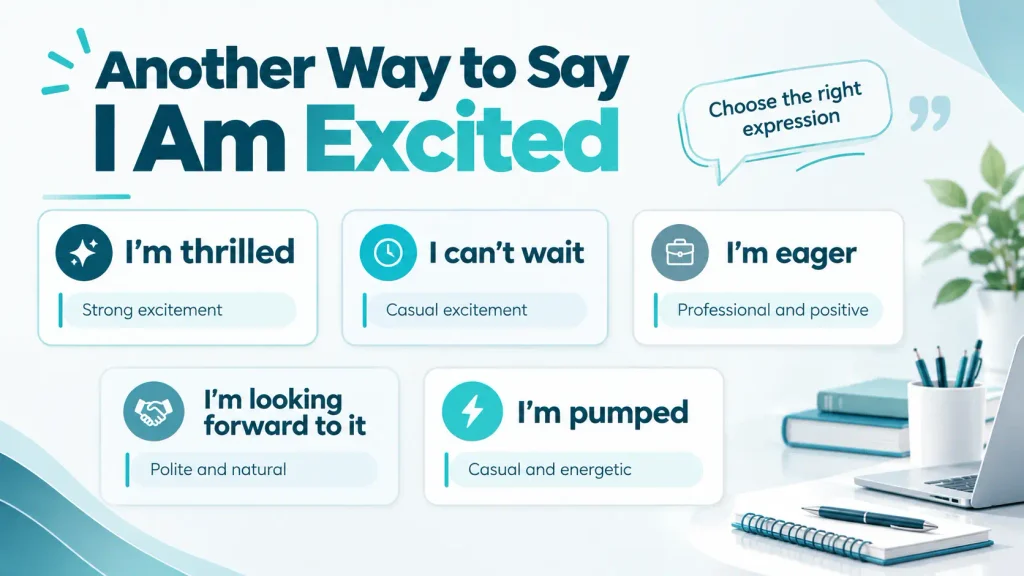
- “I’m thrilled” expresses strong happiness and excitement.
- “I can’t wait” works well in casual conversations.
- “I’m looking forward to it” sounds polite and natural in many situations.
- “I’m eager to…” works especially well in professional writing.
- “I’m pumped” and “I’m hyped” sound casual and energetic.
- Some phrases focus on anticipation rather than excitement itself.
What Does “I Am Excited” Mean?
The phrase “I am excited” means that you feel very happy, enthusiastic, or eager about something.
For example:
I am excited about my new job.
You can express the same general idea in several ways:
I’m thrilled about my new job.
I can’t wait to start my new job.
I’m really looking forward to my new job.
These alternatives share a similar meaning, but each one has a slightly different tone. “I’m thrilled” highlights happiness, while “I can’t wait” focuses more on anticipation.
25 Natural Ways to Say “I Am Excited”
1. I’m thrilled
“I’m thrilled” gives you one of the closest natural alternatives to “I’m excited.” It shows strong happiness and enthusiasm.
Example:
I’m thrilled to be joining the team.
Best for: Professional, personal, and everyday situations.
2. I can’t wait
Use “I can’t wait” when you feel very eager for something to happen. Americans use this phrase often in everyday conversation.
Example:
I can’t wait for the concert this weekend.
Best for: Casual conversations, texting, and friendly messages.
This phrase does not usually mean that you literally cannot wait. Instead, it shows strong anticipation.
3. I’m really looking forward to it
This phrase shows that you feel positive about something that will happen in the future.
Example:
I’m really looking forward to our trip next month.
Best for: Everyday conversation, emails, work, and polite communication.
As a result, this phrase can work when “I’m excited” feels too direct or informal.
4. I’m eager
“I’m eager” shows that you strongly want to do or experience something.
Example:
I’m eager to learn more about the project.
Best for: Professional, academic, and formal situations.
For example, you can use it when you want to show interest without sounding overly emotional.
5. I’m so happy about this
This simple phrase connects excitement with happiness.
Example:
I’m so happy about this opportunity.
Best for: Personal, friendly, and warm conversations.
It works especially well when something good has just happened.
6. I’m really excited about it
You do not always need a completely different phrase. You can also make the original expression sound more natural by adding emphasis.
Example:
I’m really excited about the new project.
Best for: Everyday conversation and friendly communication.
7. I’m enthusiastic about it
“Enthusiastic” shows strong interest and positive energy. It often fits ideas, projects, opportunities, and plans.
Example:
I’m enthusiastic about the new direction of the project.
Best for: Professional and formal communication.
Unlike “I’m hyped,” this phrase works well in workplace settings.
8. I’m delighted
“I’m delighted” expresses strong pleasure or happiness. It also gives your sentence a more polished tone.
Example:
I’m delighted to have the opportunity to work with your company.
Best for: Professional, formal, and polite situations.
9. I’m overjoyed
Use “I’m overjoyed” when you feel extremely happy. The phrase carries more emotion than the simple “I’m excited.”
Example:
I’m overjoyed to hear the good news.
Best for: Major personal or emotional moments.
Because it expresses very strong emotion, it may sound excessive for a small event.
10. I’m ecstatic
“I’m ecstatic” means that you feel extremely happy and excited.
Example:
I’m ecstatic about getting tickets to the show.
Best for: Personal and casual situations.
Since the word expresses very strong emotion, use it when you genuinely feel intense excitement.
11. I’m pumped
“I’m pumped” is a casual American expression for feeling excited and energized.
Example:
I’m pumped for the game tonight.
Best for: Sports, events, activities, and casual conversations.
You would usually avoid this phrase in a formal business email.
12. I’m hyped
“I’m hyped” is informal slang that means you feel very excited about something.
Example:
I’m so hyped for the new movie.
Best for: Texting, social media, and casual conversations.
For professional writing, choose a phrase such as “I’m excited,” “I’m eager,” or “I’m looking forward to it.”
13. I’m fired up
This phrase describes a strong feeling of energy, motivation, or excitement.
Example:
I’m fired up and ready to get started.
Best for: Sports, goals, projects, and energetic situations.
It can sound especially natural when you want to show both excitement and motivation.
14. I’m looking forward to it
This phrase gives you a polite and flexible alternative to “I’m excited.”
Example:
I’m looking forward to meeting everyone tomorrow.
Best for: Professional emails, everyday conversations, and polite messages.
For instance, you can use it after someone invites you to an event:
Thanks for the invitation. I’m looking forward to it.
15. I’m eager to get started
This phrase shows both excitement and a desire to begin.
Example:
I’m eager to get started on the new project.
Best for: Workplace, academic, and professional communication.
It can help you sound motivated without using overly casual language.
16. I’m excited to see what happens
Use this phrase when you feel enthusiastic about an uncertain result or future event.
Example:
I’m excited to see what happens next.
Best for: Personal, professional, and conversational situations.
The phrase combines excitement with curiosity about the future.
17. I’m counting down the days
This expression shows that you are eagerly waiting for a specific event.
Example:
I’m counting down the days until our vacation.
Best for: Trips, holidays, concerts, celebrations, and casual conversations.
It creates a more expressive and playful tone than “I’m excited.”
18. I’m really looking forward to this
This version puts more focus on the specific event, opportunity, or experience.
Example:
I’m really looking forward to this new chapter.
Best for: Personal announcements, professional updates, and conversations.
19. I’m excited beyond words
This expression shows that you feel so excited that ordinary words do not seem enough.
Example:
I’m excited beyond words to finally see my family.
Best for: Emotional and personal situations.
Because it sounds dramatic, save it for moments that genuinely feel special.
20. I’m delighted about the opportunity
This phrase gives you a polished way to express excitement about a chance or offer.
Example:
I’m delighted about the opportunity to contribute to the project.
Best for: Professional emails, applications, and workplace communication.
21. I’m enthusiastic about getting started
This phrase combines enthusiasm with a clear desire to begin.
Example:
I’m enthusiastic about getting started with the new campaign.
Best for: Professional and workplace communication.
The structure “enthusiastic about + noun or -ing form” sounds natural in this context.
22. I’m excited for what’s ahead
This phrase focuses on positive feelings about the future.
Example:
I’m excited for what’s ahead in this new chapter.
Best for: Personal announcements, career updates, and social media posts.
It can also work when you want to talk about a new stage in your life.
23. I’m looking forward to what’s next
This expression shows positive anticipation about future events.
Example:
I’m grateful for everything I’ve learned and looking forward to what’s next.
Best for: Personal and professional announcements.
It sounds positive without making your excitement seem too intense.
24. I’m buzzing
“I’m buzzing” can mean that you feel very excited or full of energy. However, Americans use this expression less often than British speakers do.
Example:
I’m buzzing after that incredible performance.
Best for: Very informal conversation.
If you want a phrase that sounds more natural in American English, “I’m pumped” or “I’m thrilled” usually works better.
25. I’m excited out of my mind
This highly informal phrase shows intense excitement.
Example:
I’m excited out of my mind about the trip!
Best for: Close friends, texting, and very casual situations.
Because the phrase exaggerates your emotion, avoid it in formal or professional writing.
Which Alternative Should You Use?
The right phrase depends on the tone you want.
| Alternative | Tone | Best Context |
|---|---|---|
| I’m thrilled | Warm and enthusiastic | General, work, personal |
| I can’t wait | Casual and energetic | Conversation, texting |
| I’m looking forward to it | Polite and positive | Work and everyday English |
| I’m eager to | Polished and motivated | Professional and academic |
| I’m enthusiastic about it | Professional and positive | Workplace and formal writing |
| I’m delighted | Warm and polished | Professional and formal |
| I’m overjoyed | Highly emotional | Personal celebrations |
| I’m ecstatic | Extremely enthusiastic | Major personal events |
| I’m pumped | Energetic and casual | Sports and activities |
| I’m hyped | Informal and energetic | Texting and social media |
| I’m fired up | Energetic and motivated | Goals, sports, projects |
| I’m counting down the days | Playful and excited | Trips and upcoming events |
| I’m excited for what’s ahead | Positive and hopeful | Personal or professional updates |
| I’m buzzing | Very informal | Casual conversation |
Professional Ways to Say “I Am Excited”
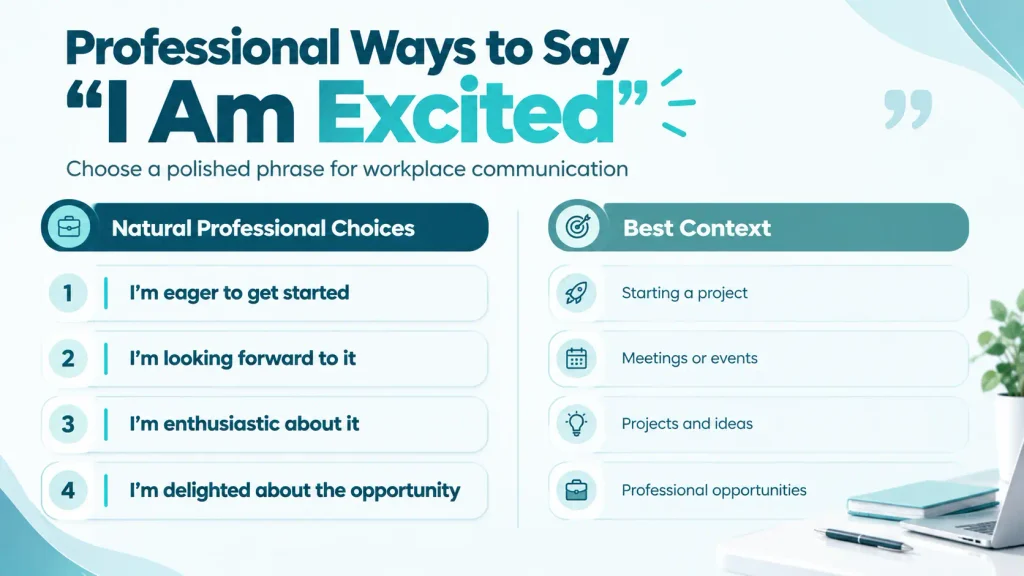
A workplace message often needs a positive tone without sounding too casual. In that case, these phrases work well:
- I’m looking forward to it.
- I’m eager to get started.
- I’m enthusiastic about the opportunity.
- I’m delighted about the opportunity.
- I’m excited about the opportunity.
- I’m looking forward to working with you.
- I’m eager to contribute.
- I’m pleased about the opportunity.
Example
Instead of:
I’m super hyped to work with your company!
Try:
I’m excited about the opportunity to work with your company, and I look forward to contributing to the team.
This version sounds positive while keeping a professional tone.
Casual Ways to Say “I Am Excited”
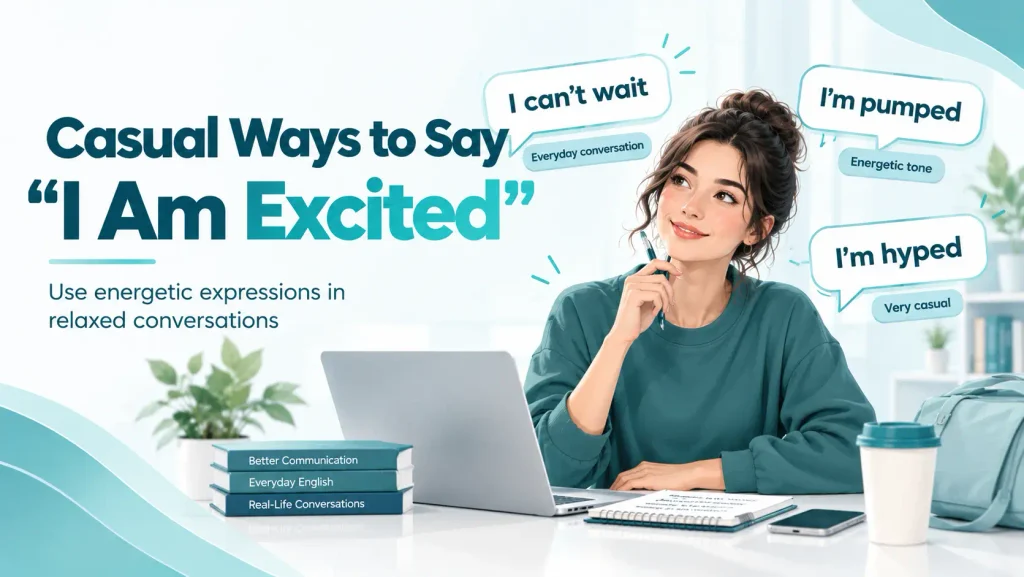
For friends, texts, and social media, you have more freedom to use energetic expressions.
Try:
- I can’t wait!
- I’m so excited!
- I’m pumped!
- I’m hyped!
- I’m fired up!
- I’m counting down the days!
- I’m so ready!
- I’m beyond excited!
For example:
I can’t wait for the trip!
This sounds much more conversational than:
I am enthusiastic about the upcoming trip.
Both sentences express positive anticipation. Still, the first one fits casual conversation much better.
“I’m Excited” vs. “I’m Looking Forward to It”
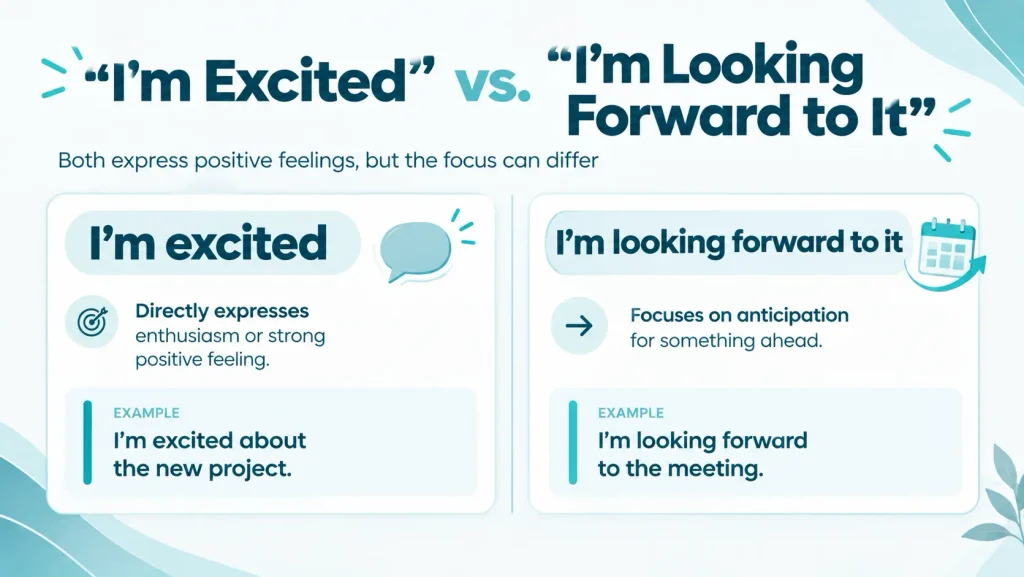
These two phrases often have similar meanings, but they put emphasis on different things.
“I’m excited” describes how you feel now.
I’m excited about the concert.
“I’m looking forward to it” focuses on your anticipation of something in the future.
I’m looking forward to the concert.
You can also use both ideas together:
I’m really excited, and I’m looking forward to seeing everyone there.
Therefore, “I’m looking forward to it” can sound more measured, while “I’m excited” can sound more direct and emotional.
Common Mistakes to Avoid
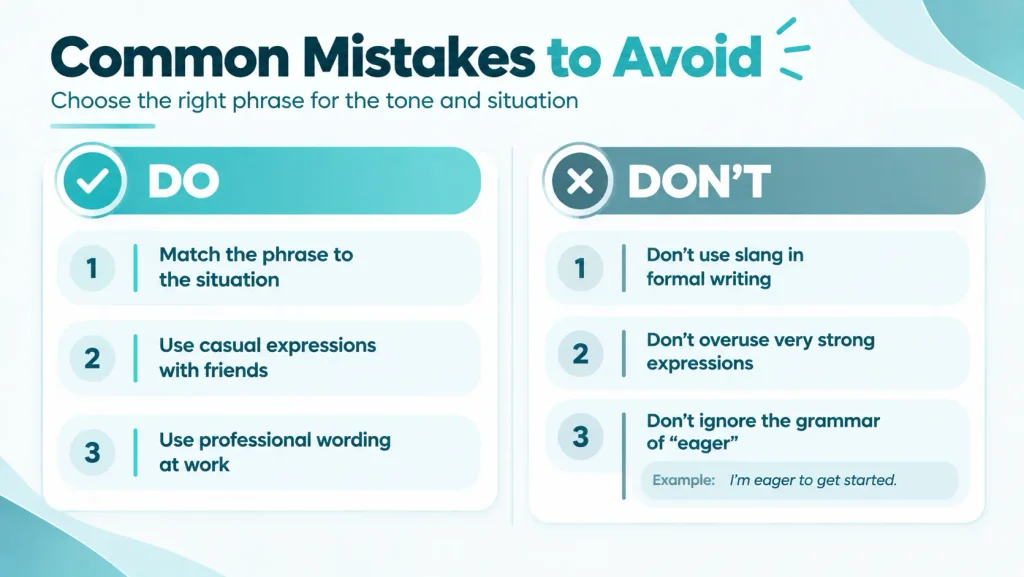
1. Using slang in formal writing
Words such as “hyped” and “pumped” sound casual. They may not fit a formal email, application, or business document.
Instead of:
I’m hyped about the opportunity.
Use:
I’m excited about the opportunity.
Or:
I’m enthusiastic about the opportunity.
2. Treating every phrase as an exact synonym
Not every alternative expresses exactly the same feeling.
For example, “I’m looking forward to it” focuses on anticipation. On the other hand, “I’m overjoyed” focuses on very strong happiness.
Choose the phrase that matches your actual emotion.
3. Overusing very strong expressions
Words such as “ecstatic” and “overjoyed” express intense emotions.
For an ordinary event, you might say:
I’m looking forward to the meeting.
For a major personal event, you could say:
I’m absolutely thrilled to celebrate this milestone.
This difference helps your writing sound natural.
4. Using “eager” with the wrong structure
The word “eager” commonly appears with “to + verb” or “for + noun.”
Correct:
I’m eager to learn more.
I’m eager for the opportunity.
For another structure, use a phrase such as:
I’m enthusiastic about the project.
That sounds more natural than saying “I’m eager about the project.”
Frequently Asked Questions
What is another way to say “I am excited”?
You can say “I’m thrilled,” “I can’t wait,” “I’m eager,” “I’m looking forward to it,” or “I’m enthusiastic about it.” Your choice depends on the level of excitement and the situation.
What is a professional way to say “I am excited”?
Good professional options include “I’m looking forward to it,” “I’m eager to get started,” “I’m enthusiastic about the opportunity,” and “I’m delighted about the opportunity.”
What is a casual way to say “I am excited”?
For casual conversations, try “I can’t wait,” “I’m pumped,” “I’m hyped,” “I’m so ready,” or “I’m fired up.”
Is “I can’t wait” the same as “I’m excited”?
They have similar meanings, but the focus differs. “I’m excited” describes your current emotion, while “I can’t wait” emphasizes your eagerness for something to happen.
Is “I’m thrilled” stronger than “I’m excited”?
Generally, “I’m thrilled” sounds more expressive and often suggests a high level of happiness or enthusiasm. The exact strength still depends on the situation.
What is another way to say “I am excited for the opportunity”?
You can say:
I’m thrilled about the opportunity.
I’m eager to contribute.
I’m looking forward to the opportunity.
I’m delighted to have this opportunity.
I’m enthusiastic about the opportunity.
Can I say “I’m hyped” in a professional email?
Usually, it is better to avoid “I’m hyped” in formal professional writing. Instead, choose “I’m excited,” “I’m eager,” “I’m enthusiastic,” or “I’m looking forward to it.”
Final Thoughts
You can replace “I am excited” with many natural expressions, but the best choice depends on your audience and situation. Use “I’m thrilled” for strong enthusiasm, “I can’t wait” for casual excitement, “I’m looking forward to it” for polite anticipation, and “I’m eager to…” for a more professional tone.
Most importantly, choose a phrase that matches the feeling you want to express. A natural alternative should not only have a similar meaning; it should also fit the context.

Role: English Language & Communication Writer
Daniel Carter is an English language writer specializing in workplace communication, professional vocabulary, resumes, emails, and career-focused English.