
If you are looking for another way to say coming soon, good choices include “arriving soon,” “available soon,” “launching soon,” “on the way,” and “coming shortly.” The best alternative depends on what you are announcing. For a product, “available soon” works well; for a website or event, “launching soon” or “coming up” may sound more natural.
Key Takeaways
- “Coming soon” means something is expected to happen, arrive, or become available in the near future.
- “Arriving soon” works well for products, people, and physical things.
- “Launching soon” is especially natural for websites, products, apps, and businesses.
- “Available soon” focuses on when something can be accessed, bought, or used.
- “On the way” is more casual and conversational.
- “Forthcoming” is a more formal alternative, especially in professional or written contexts.
What Does “Coming Soon” Mean?
“Coming soon” tells people that something will happen or become available in the near future.
It is common in announcements, websites, advertisements, product pages, event promotions, and everyday conversation.
For example:
Our new collection is coming soon.
This tells the reader that the collection is not available yet but is expected to become available in the near future.
The phrase is intentionally flexible. It does not give a specific date, so it works when the exact timing has not been announced.
If you are searching for another way to say coming soon, you may want a phrase that sounds more specific, professional, casual, or informative.
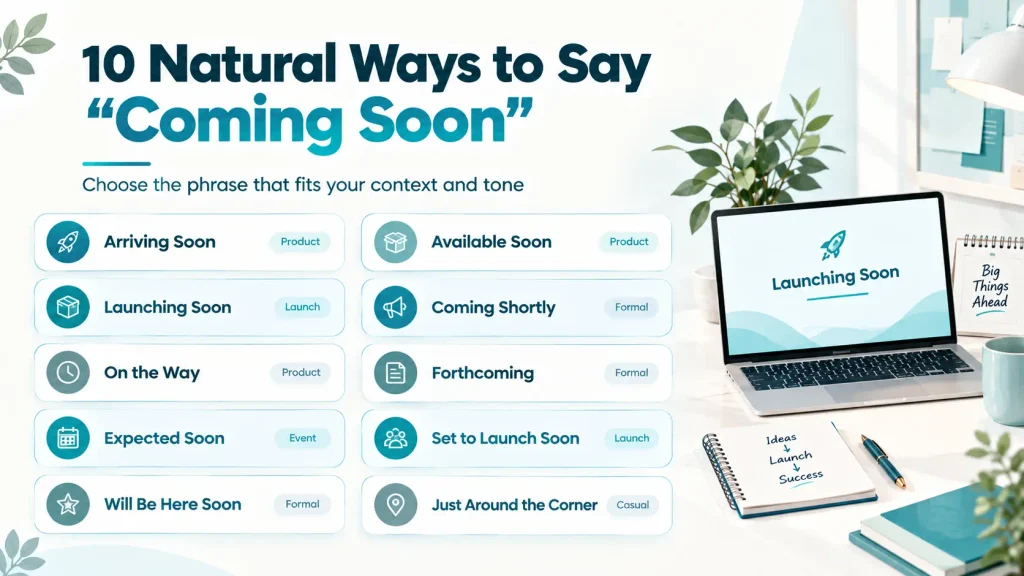
10 Natural Ways to Say “Coming Soon”
1. Arriving Soon
“Arriving soon” is a natural alternative when something is expected to arrive or become available shortly.
It works especially well for products, deliveries, new collections, and physical items.
Example:
Our new spring collection is arriving soon.
Best for: Products, collections, deliveries, and announcements.
2. Available Soon
“Available soon” focuses on when something will become accessible, usable, or ready to purchase.
It is particularly useful for products, services, apps, downloads, and online content.
Example:
The new course will be available soon.
This phrase can sound slightly more informative than “coming soon” because it tells the reader what will change: the item will become available.
Best for: Products, services, courses, apps, downloads, and content.
3. Launching Soon
“Launching soon” is one of the most useful alternatives for a new product, business, website, app, service, or collection.
It suggests that something is being officially introduced to the public.
Example:
Our new website is launching soon.
Use this phrase when the important event is the actual launch rather than simply the arrival of something.
Best for: Websites, apps, businesses, products, services, and campaigns.
4. Coming Shortly
“Coming shortly” has almost the same meaning as “coming soon,” but it can sound a little more formal.
It works well in announcements and written communication.
Example:
More details are coming shortly.
The phrase is useful when you want to tell people that an update, announcement, or change will happen soon without giving an exact date.
Best for: Announcements, updates, information, and formal writing.
5. On the Way
“On the way” is a casual and conversational alternative. It suggests that something is already being prepared or is expected to arrive.
Example:
A new update is on the way.
It can also describe something physical:
Your order is on the way.
However, the meaning can change slightly depending on the context. “On the way” often suggests movement or progress, while “coming soon” simply indicates that something will happen in the near future.
Best for: Casual announcements, products, updates, and conversation.
6. Forthcoming
“Forthcoming” is a more formal alternative to “coming soon.” It is commonly used in professional, academic, publishing, and business contexts.
Example:
Further information will be provided in the forthcoming announcement.
It can also describe something that is expected to appear or happen soon.
Because “forthcoming” sounds formal, it may feel unnatural in casual conversation.
Best for: Professional writing, academic writing, publications, announcements, and formal communication.
7. Expected Soon
“Expected soon” is useful when something is anticipated but the exact timing may not be certain.
Example:
The next software update is expected soon.
This wording is especially useful when you want to avoid making the stronger promise implied by a definite announcement.
Compare:
- The update is coming soon. — More direct.
- The update is expected soon. — Slightly more cautious.
Best for: Updates, releases, products, announcements, and situations where timing is not exact.
8. Set to Launch Soon
“Set to launch soon” gives an announcement a slightly more polished and professional tone.
It means something is scheduled or expected to launch in the near future.
Example:
The company’s new mobile app is set to launch soon.
This phrase is more specific than simply saying “coming soon” because it emphasizes the planned launch.
Best for: Apps, businesses, products, websites, services, and new projects.
9. Will Be Here Soon
“Will be here soon” is a friendly and conversational option.
It works particularly well when talking about a person, product, event, or something people are waiting for.
Example:
The weekend will be here soon.
For an announcement, it can create a warmer tone than the more neutral “coming soon.”
Best for: Casual conversation, social media, friendly announcements, and events.
10. Just Around the Corner
“Just around the corner” is an idiomatic way to say that something is very close to happening.
It often creates a sense of anticipation or excitement.
Example:
The holiday season is just around the corner.
Unlike “coming soon,” this expression is usually more figurative and conversational.
Best for: Holidays, events, seasons, launches, and informal promotional writing.
Alternatives for “Coming Soon” at a Glance
| Alternative | Meaning/Use | Tone | Best Context |
| Arriving soon | Something will arrive shortly | Neutral | Products, collections |
| Available soon | Something will become accessible | Neutral | Products, services, apps |
| Launching soon | Something will officially launch | Professional | Websites, products, apps |
| Coming shortly | Something will happen soon | Neutral/Formal | Announcements, updates |
| On the way | Something is approaching or being prepared | Casual | Updates, products |
| Forthcoming | Something is expected in the near future | Formal | Business, academic writing |
| Expected soon | Something is anticipated soon | Neutral | Updates, releases |
| Set to launch soon | Something is planned to launch soon | Professional | Products, websites |
| Will be here soon | Something will arrive or happen soon | Friendly | Conversation, events |
| Just around the corner | Something is very close to happening | Casual/Idiomatic | Events, seasons |
For more help with natural English expressions, you can also explore other Vocabulary, Idioms & Slang articles on the site.
Which Alternative Should You Use?
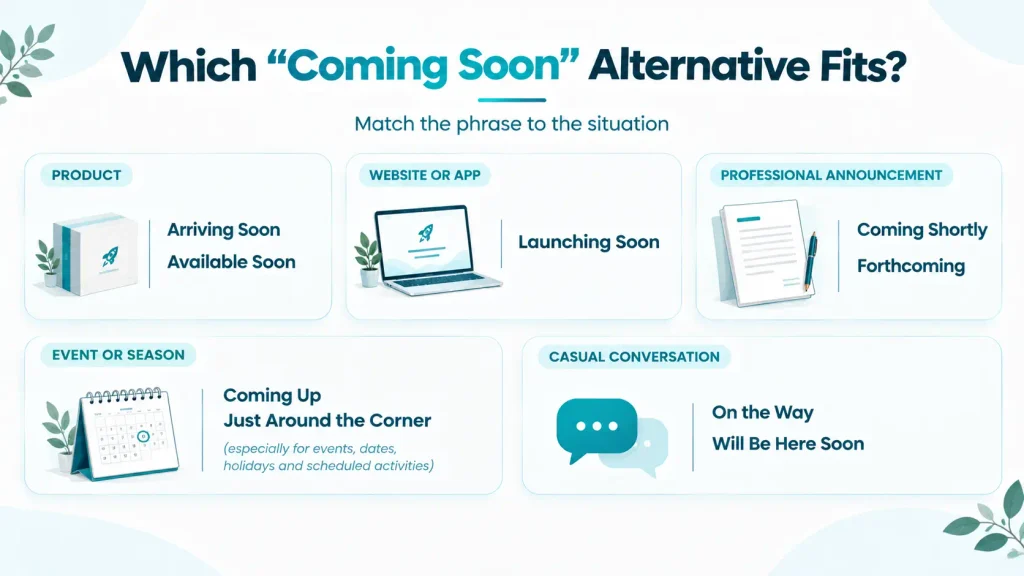
The best replacement depends on what you are talking about. If you are wondering about another way to say coming soon, start by considering whether you are describing a product, website, event, announcement, or casual situation.
For a Product
Use “arriving soon” or “available soon.”
Our new skincare collection is arriving soon.
The new product will be available soon.
“Available soon” is especially useful if customers will be able to buy or access the product once it is released.
For a Website or App
Use “launching soon” or “set to launch soon.”
Our new website is launching soon.
The app is set to launch soon.
These phrases clearly communicate that the website or app is about to be officially released.
For an Event
Use “coming up,” “happening soon,” or “just around the corner,” depending on the tone.
Our annual conference is coming up.
The holiday season is just around the corner.
These options can sound more natural than “coming soon” when talking about something that is already scheduled.
For a Professional Announcement
Use “coming shortly,” “forthcoming,” or “expected soon.”
Additional details are coming shortly.
A forthcoming announcement will provide more information.
The choice depends on how formal you want the message to sound.
For Casual Conversation
Use “on the way,” “will be here soon,” or “just around the corner.”
Don’t worry. Your order is on the way.
Summer is just around the corner.
These expressions feel more natural in everyday conversation than highly formal alternatives.
“Coming Soon” vs. “Launching Soon”
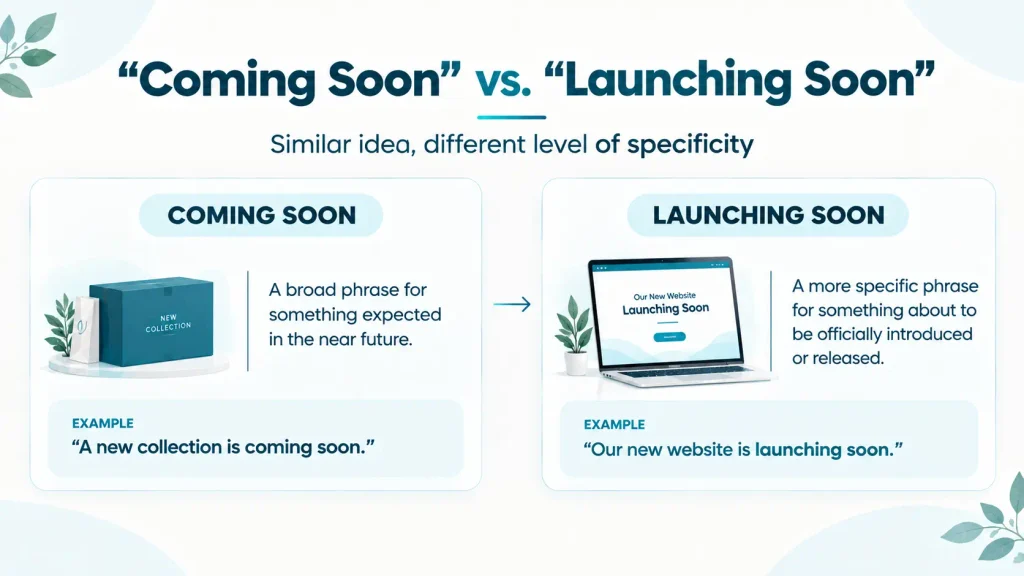
These phrases are related, but they are not always interchangeable.
Coming soon is broad. It simply means something is expected in the near future.
Launching soon is more specific. It means something is about to be officially introduced or released.
For example:
A new collection is coming soon.
This does not necessarily say anything about the launch process.
A new collection is launching soon.
This specifically emphasizes the collection’s release.
If you’re announcing a new website, app, product, or business, “launching soon” is often the clearer choice.
“Coming Soon” vs. “Available Soon”
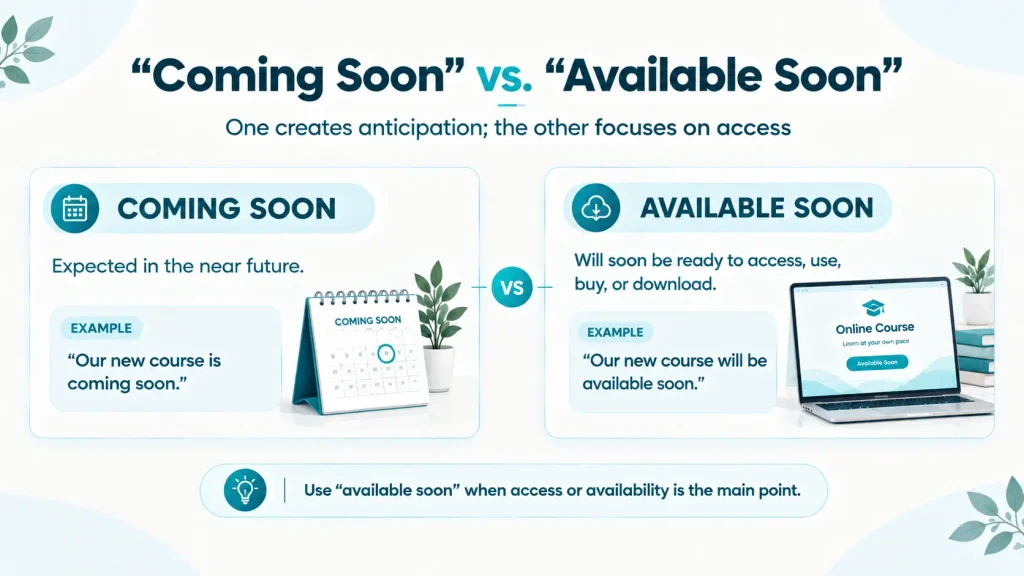
.The difference is also useful when writing product or service announcements.
Coming soon creates anticipation but does not specify exactly what will happen.
Available soon tells the reader that they will soon be able to access, purchase, use, or download something.
For example:
Our new course is coming soon.
Our new course will be available soon.
The second version gives the reader more practical information.
For another useful language comparison, you can link this section to a related article about choosing natural alternatives in English.
Common Mistakes When Replacing “Coming Soon”
Using “Forthcoming” in Casual Conversation
“Forthcoming” is grammatically correct, but it can sound overly formal in everyday speech.
Instead of:
My vacation is forthcoming.
A natural speaker would usually say:
My vacation is coming up.
Using “Launching” for Everything
“Launching soon” is appropriate when something is being officially introduced. It does not work equally well for every situation.
For example, a person arriving at a restaurant is not normally described as “launching soon.”
Use “arriving soon” or “will be here soon” instead.
Treating “On the Way” as an Exact Synonym
“On the way” can imply movement or progress.
Your package is on the way.
But “coming soon” can describe something that has not physically started moving.
Our new website is coming soon.
So, the two phrases overlap, but they are not interchangeable in every sentence.
Promising an Exact Time Without Giving One
“Coming soon” deliberately avoids a specific date. If you know the actual date, a clearer announcement may be better.
Instead of:
Our new store is coming soon.
You could write:
Our new store opens October 15.
A specific date gives readers more useful information when one is available.
Frequently Asked Questions
What is a professional way to say “coming soon”?
“Forthcoming,” “coming shortly,” “expected soon,” and “set to launch soon” can work in professional contexts. The best choice depends on whether you are discussing an announcement, product, service, or launch.
What is a casual way to say “coming soon”?
“On the way,” “will be here soon,” and “just around the corner” are natural casual alternatives. “Coming up” also works well for events or things that are scheduled to happen soon.
What is another way to say “coming soon” for a website?
“Launching soon” is a natural choice for a new website. You can also use “website launching shortly” or “our new website will be available soon.”
What is another way to say “coming soon” for a product?
“Arriving soon” and “available soon” are useful choices. “Launching soon” works when you are emphasizing the product’s official release.
Is “forthcoming” the same as “coming soon”?
They can have similar meanings, but “forthcoming” is more formal. It is often used for information, publications, announcements, or events that are expected in the near future.
Is “coming shortly” correct?
Yes. “Coming shortly” is a grammatically correct alternative to “coming soon.” It can sound slightly more formal and is particularly common in written announcements.
Can I say “coming up” instead of “coming soon”?
Yes, but “coming up” is especially natural for events, dates, holidays, and scheduled activities.
The conference is coming up next month.
It is less natural when describing a product that has not yet been released.
Final Thoughts
If you need another way to say coming soon, the best choice depends on the context. Use “arriving soon” for products, “available soon” for access or availability, and “launching soon” for new websites, apps, products, or businesses. For a more formal tone, “forthcoming” or “coming shortly” can work well.
The key is to choose a phrase that matches both the situation and the tone you want.

Role: English Language & Communication Writer
Daniel Carter is an English language writer specializing in workplace communication, professional vocabulary, resumes, emails, and career-focused English.