

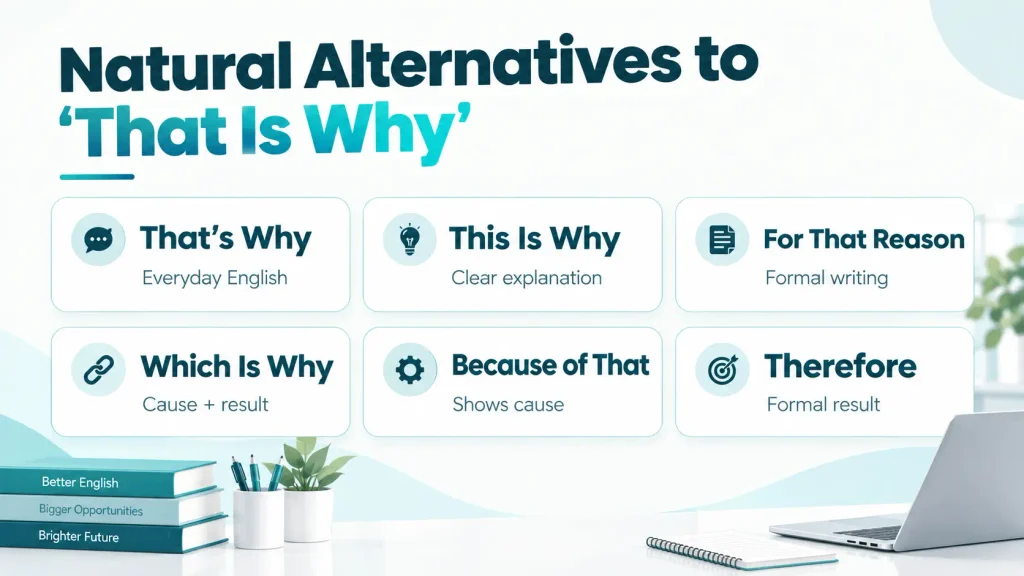
Looking for another way to say that is why? The best alternative depends on your sentence, tone, and writing style. Natural options include “that’s why,” “this is why,” “for that reason,” “which is why,” “because of that,” “as a result,” and “therefore.”
Some alternatives sound natural in everyday American English, while others are better suited to academic, professional, or formal writing.
Key Takeaways
- “That’s why” is the most natural everyday alternative to “that is why.”
- “This is why” works well when emphasizing a reason or explanation.
- “For that reason” is useful in formal and professional writing.
- “Which is why” connects a cause with its result in the same sentence.
- “Because of that” clearly shows a cause-and-effect relationship.
- “Therefore,” “thus,” and “consequently” are more formal choices.
- “So” is often the simplest option in everyday English.
- The best alternative depends on the meaning and structure of your sentence.
What Does “That Is Why” Mean?
“That is why” introduces the reason something happened or explains why a situation exists.
For example:
Maya missed the meeting. That is why she called the client afterward.
In this example, “that is why” means that missing the meeting was the reason she called the client.
In everyday American English, people often use the contraction “that’s why” instead:
I was running late. That’s why I took a taxi.
Both expressions have the same basic meaning, but “that’s why” usually sounds more natural and conversational.
15 Alternatives to “That Is Why”
1. That’s Why
If you need another way to say that is why in casual or everyday English, “that’s why” is usually the most natural choice.
Example:
I had an early appointment. That’s why I left home at 7 a.m.
Best for: Conversation, texting, emails, and everyday writing.
Tip: Avoid using “so” and “that’s why” together when they express the same cause-and-effect relationship.
Less natural:
I was tired, so that’s why I went home.
Better:
I was tired, so I went home.
Or:
I was tired. That’s why I went home.
2. This Is Why
“This is why” is useful when you want to emphasize a reason or explanation that is being discussed.
Example:
The road becomes slippery during heavy rain. This is why drivers should slow down.
Best for: Explanations, articles, presentations, and everyday speech.
“ This is why” can sound slightly more immediate because it points directly to the situation or explanation just mentioned.
3. For That Reason
“For that reason” is a clear and natural alternative when you want to explain the reason for a result.
Example:
The store has limited parking. For that reason, we recommend arriving early.
Best for: Professional, academic, and formal writing.
It usually sounds more formal than “that’s why.”
4. For This Reason
“For this reason” is similar to “for that reason,” but it often refers to a reason that has just been explained or is being emphasized.
Example:
The software requires an internet connection. For this reason, users should check their connection before starting the update.
Best for: Essays, reports, instructions, and professional communication.
5. Which Is Why
“Which is why” connects an earlier fact or action with its result.
Example:
The restaurant was fully booked, which is why we decided to eat somewhere else.
Best for: Conversation, storytelling, explanations, and natural writing.
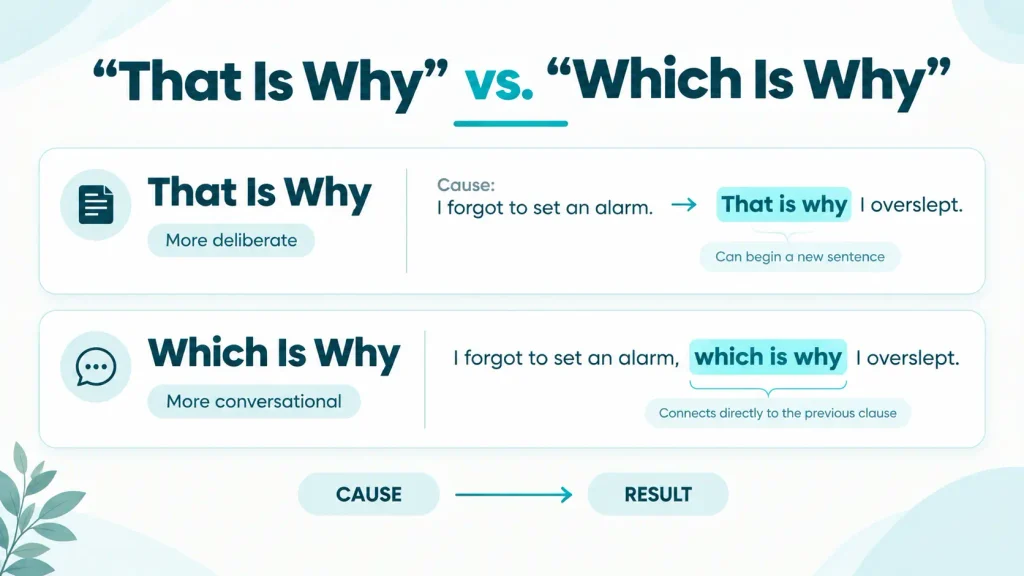
Unlike “that is why,” “which is why” usually connects directly to the previous clause rather than beginning a completely separate sentence.
Compare:
I forgot to set an alarm. That is why I overslept.
I forgot to set an alarm, which is why I overslept.
Both sentences express a similar cause-and-result relationship, but the sentence structures are different.
6. Because of That
“Because of that” directly identifies something previously mentioned as the cause of a result.
Example:
The weather changed suddenly. Because of that, the outdoor event was canceled.
Best for: Everyday English, neutral writing, and explanations.
It is especially useful when you want to make the cause-and-effect relationship very clear.
7. As a Result
“As a result” focuses more on the consequence of an action or situation.
Example:
The company updated its security system. As a result, customer data is better protected.
Best for: Professional, academic, and informational writing.
Although “as a result” can sometimes replace “that is why,” it is not always an exact synonym. It emphasizes the result, while “that is why” often emphasizes the reason.
8. Therefore
“Therefore” is a formal way to introduce a conclusion or result.
Example:
The application was incomplete. Therefore, it could not be processed.
Best for: Academic writing, reports, professional documents, and formal explanations.
In casual conversation, “that’s why” or “so” will usually sound more natural.
9. Thus
“Thus” can introduce a result or conclusion based on something previously stated.
Example:
The roads were closed because of flooding. Thus, deliveries were delayed.
Best for: Academic, technical, analytical, and formal writing.
“Thus” is grammatically correct but is less common in everyday American conversation.
10. Consequently
“Consequently” means that something happened as a result of a previous event or situation.
Example:
The shipment arrived late. Consequently, the store had to postpone the launch.
Best for: Formal, professional, and academic writing.
Because it has a formal tone, it may sound too serious for casual conversations or text messages.
11. So
Sometimes, “so” is the simplest way to express the same cause-and-effect idea.
Example:
I wasn’t feeling well, so I stayed home.
This communicates the same basic relationship as:
I wasn’t feeling well. That is why I stayed home.
Best for: Everyday speech, casual writing, and simple explanations.
When possible, “so” can make a sentence shorter and more natural.
12. That’s the Reason
“That’s the reason” emphasizes the explanation behind something.
Example:
I wanted to avoid traffic. That’s the reason I left early.
Best for: Conversation, explanations, and neutral writing.
However, in many situations, “that’s why” sounds more natural and concise.
13. That’s the Reason for This
“That’s the reason for this” can explain why a particular situation, change, or problem exists.
Example:
The team needed more time to test the software. That’s the reason for the delay.
Best for: Explanations and professional communication.
This structure works particularly well when the result is a noun, such as delay, change, decision, or problem.
14. Accordingly
“Accordingly” can introduce an action or decision that follows logically from a previous situation.
Example:
The original schedule was no longer practical. Accordingly, the team revised the timeline.
Best for: Formal and professional writing.
“Accordingly” is not a direct replacement for “that is why” in every sentence. Use it when the following action is a logical response to the situation described before it.
15. Hence
“Hence” can express a result or conclusion and is more formal than most everyday alternatives.
Example:
The device was not connected to the network, hence the failed update.
Best for: Formal, technical, and academic writing.
For ordinary American English, “that’s why,” “so,” or “because of that” will usually sound more natural.
Best Alternatives to “That Is Why” by Tone
If you are deciding another way to say that is why, the right choice depends on the tone of your sentence.
| Alternative | Tone | Best Context | Main Function |
|---|---|---|---|
| That’s why | Casual/neutral | Conversation, everyday writing | Gives a reason |
| This is why | Neutral | Explanations, articles | Emphasizes a reason |
| For that reason | Formal/neutral | Work, essays | Gives a reason |
| For this reason | Formal/neutral | Reports, academic writing | Highlights a reason |
| Which is why | Neutral | Conversation, storytelling | Connects cause and result |
| Because of that | Neutral | Everyday writing | Shows a cause |
| As a result | Neutral/formal | Reports, explanations | Shows a consequence |
| Therefore | Formal | Academic/professional writing | Shows a logical result |
| Thus | Formal | Academic/technical writing | Shows a conclusion |
| Consequently | Formal | Reports, formal writing | Shows a consequence |
| So | Casual/neutral | Everyday English | Connects cause and result |
| That’s the reason | Neutral | Conversation, explanations | Emphasizes the reason |
| That’s the reason for this | Neutral/formal | Professional explanations | Explains a situation |
| Accordingly | Formal | Professional writing | Shows a resulting action |
| Hence | Formal | Academic/technical writing | Shows a result or conclusion |
“That Is Why” vs. “That’s Why”
“That is why” and “that’s why” have essentially the same meaning.
“That is why” can sound more deliberate:
The instructions were unclear. That is why several users made mistakes.
“That’s why” is more common in everyday American English:
The instructions were unclear. That’s why several users made mistakes.
For casual conversations, texts, and friendly communication, “that’s why” is usually the more natural choice.
For formal writing, you can use “that is why,” “for that reason,” or another transition that fits the sentence.
“That Is Why” vs. “This Is Why”
The choice between “that” and “this” depends on what you are referring to.
Use “this is why” when the reason feels immediate or directly connected to the explanation:
The road gets extremely icy at night. This is why drivers need to be careful.
Use “that is why” when referring back to an established fact or situation:
The road was covered in ice. That is why the school closed.
The difference can be subtle, and both expressions may be appropriate depending on the context.
“That Is Why” vs. “Which Is Why”
These expressions have similar meanings but different grammatical structures.
“That is why” can introduce a new sentence:
I forgot to set an alarm. That is why I overslept.
“Which is why” normally connects the result directly to the previous clause:
I forgot to set an alarm, which is why I overslept.
Use “which is why” when you want the cause and result to flow together in one sentence.
“That Is Why” vs. “Therefore”
Both expressions can introduce a result, but their tones are different.
Casual:
The store was closed. That’s why we went somewhere else.
Formal:
The store was closed. Therefore, we went somewhere else.
Both are grammatically correct, but “therefore” sounds more formal and analytical.
For everyday American English, “that’s why” or “so” will often sound more natural. For academic or professional writing, “therefore” may be a better fit when you are presenting a logical conclusion.
Common Mistakes With “That Is Why”
Using “So” and “That’s Why” Together
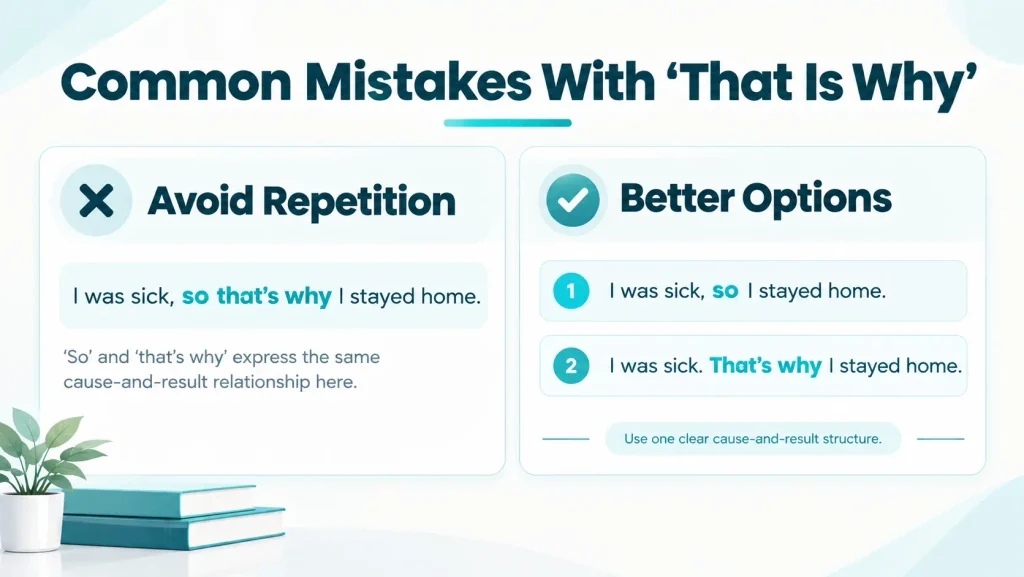
Avoid using both expressions when they serve the same purpose.
Incorrect or unnecessarily repetitive:
I was sick, so that’s why I stayed home.
Better:
I was sick, so I stayed home.
Or:
I was sick. That’s why I stayed home.
Treating Every Alternative as an Exact Synonym
Not every alternative has exactly the same meaning or grammatical function.
For example, “therefore,” “consequently,” and “as a result” focus strongly on a consequence. “That’s why” often sounds more like an explanation of the reason.
Choose the expression that matches the relationship between your ideas.
Using Formal Words in Casual Conversations
A sentence such as:
I missed the bus; consequently, I arrived late.
is grammatically correct, but it may sound too formal in everyday conversation.
A more natural version is:
I missed the bus, so I was late.
Using “Which Is Why” Without a Clear Connection
“Which is why” should clearly refer to the situation or action that comes before it.
Clear:
The restaurant was full, which is why we went somewhere else.
Unclear:
We changed our plans, which is why.
The second sentence is incomplete because the reader is left waiting for the result.
Frequently Asked Questions
What is another way to say “that is why” in casual English?
The most natural casual alternative is “that’s why.” Depending on the sentence, “so” and “because of that” can also work well.
What is a formal way to say “that is why”?
Formal alternatives include “for that reason,” “for this reason,” “therefore,” “thus,” and “consequently.” Choose the option that best matches the relationship between your ideas.
Is “that’s why” grammatically correct?
Yes. “That’s why” is the standard contraction of “that is why” and is widely used in American English.
Is “which is why” the same as “that is why”?
They express a similar cause-and-effect relationship, but their sentence structures are different. “That is why” can begin a new sentence, while “which is why” normally connects to the preceding clause.
Can I use “therefore” instead of “that is why”?
Sometimes. Both can express a result, but “therefore” has a more formal tone and often introduces a logical conclusion.
What is the simplest alternative to “that is why”?
“That’s why” is usually the simplest and most natural alternative. In many sentences, “so” can make the same idea even more concise.
What is another way to say “that is why” in an essay?
For an essay, consider “for this reason,” “for that reason,” “therefore,” “thus,” or “as a result.” Choose the phrase that accurately describes the connection between the previous idea and the result.
Final Takeaway
There is no single replacement that works in every situation. If you need another way to say that is why in everyday American English, “that’s why,” “so,” and “because of that” are natural choices.
For formal or academic writing, “for this reason,” “for that reason,” “therefore,” “thus,” and “consequently” may be more appropriate.
The most important thing is to match the phrase to your sentence’s meaning and tone instead of replacing “that is why” mechanically. This will make your writing sound clearer, more natural, and more appropriate for your audience.

Role: Author & Contributing Writer
Olivia Bennett is a dedicated Author at Elite’s Collective, focused on delivering clear, well-researched, and engaging articles tailored to the audience.