
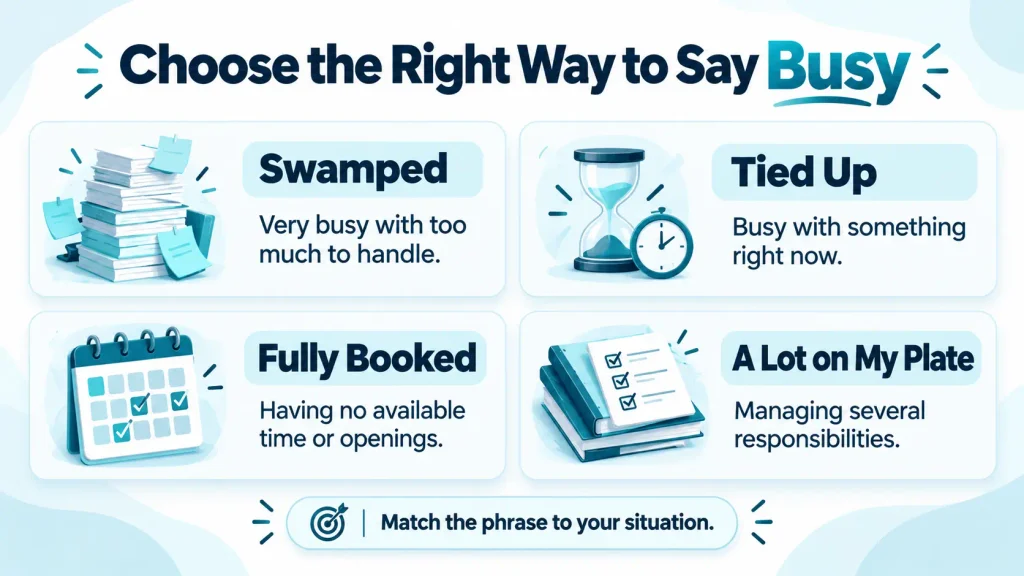
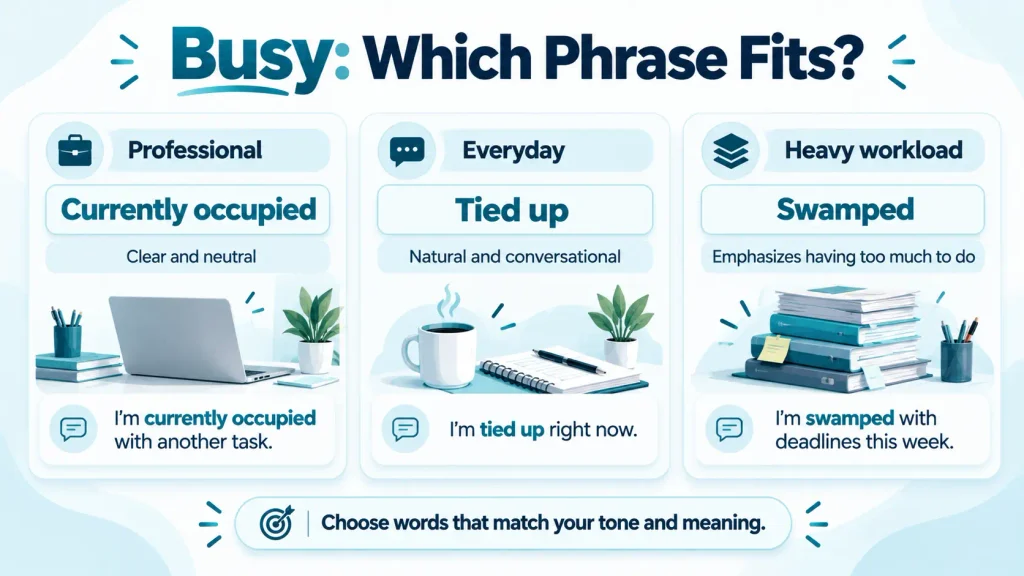
The best alternatives to “busy” include occupied, tied up, swamped, slammed, booked, and have a lot on my plate. The right expression depends on your situation. Use “occupied” for a neutral tone, “tied up” when you cannot respond immediately, and “swamped” when you have too much work to handle easily.
Key Takeaways
- Professional: Occupied, fully booked, and managing a heavy workload.
- Casual: Tied up, slammed, and swamped.
- Overwhelmed: Snowed under, stretched thin, and up to my ears in work.
- Unavailable: Engaged, booked, or unable to make time.
- For everyday conversations: I have a lot on my plate is a natural alternative.
What Does Busy Mean?
The word “busy” describes someone who is occupied with work, activities, or other responsibilities. It can also describe a place with many people or a period filled with activity.
For example, “I’m busy today” could mean you have several assignments to finish, appointments to attend, or personal responsibilities to manage.
However, the word does not always explain why someone has limited time. Choosing a more specific expression can make your message clearer and more natural.
15 Other Ways to Say Busy
1. Occupied
Best for: Professional, neutral, and formal situations.
“Occupied” means you are engaged in an activity and cannot easily give your attention to something else. It is a good choice when you want a polite, neutral alternative.
Example: “I’m occupied with a few important tasks this morning.”
Use this expression when you want to sound professional without suggesting that you are overwhelmed.
2. Tied Up
Best for: Everyday conversations and workplace communication.
“Tied up” means you are temporarily unable to do something because another task or commitment needs your attention.
Example: “I’m tied up in a meeting right now. Can I call you back in an hour?”
This phrase is especially useful when explaining why you cannot respond immediately.
3. Swamped
Best for: Casual conversations and heavy workloads.
“Swamped” describes having so much work or so many responsibilities that managing everything feels difficult.
Example: “I’m swamped with client requests this week.”
Unlike “busy,” this word suggests a heavier workload and may imply some pressure.
4. Slammed
Best for: Informal American English, especially at work.
“Slammed” means extremely busy, often because several tasks or demands arrive at once.
Example: “Our team is slammed with orders today.”
This expression is common in casual workplace conversations. It is less suitable for formal reports or professional correspondence.
5. Fully Booked
Best for: Appointments, schedules, and professional services.
“Fully booked” means there are no available time slots or appointments left.
Example: “I’m fully booked this afternoon, but I have an opening tomorrow morning.”
This is more precise than “busy” when your schedule has no free space.
6. Have a Lot on My Plate
Best for: Everyday conversations and workplace discussions.
This expression means you have many responsibilities or tasks to manage.
Example: “I have a lot on my plate this week, so I may need an extra day to finish the project.”
It sounds natural and explains that you have several competing priorities. It does not necessarily mean you are unable to accept anything else.
7. Snowed Under
Best for: Informal conversations about excessive work.
“Snowed under” means overwhelmed by a large amount of work or responsibilities.
Example: “I’m snowed under with assignments before the deadline.”
Although Americans use this expression, it can sound less conversational than “swamped” or “slammed” in some situations.
8. Up to My Ears in Work
Best for: Casual conversations and humorous emphasis.
This expression means you have an unusually large amount of work to complete.
Example: “I’m up to my ears in paperwork this week.”
It is more vivid than “busy” and emphasizes how much work you have. The expression can also be used with other nouns, as in “up to my ears in emails.”
9. Engaged
Best for: Formal or polite communication.
“Engaged” can mean occupied with an activity or commitment, especially in formal language.
Example: “She is currently engaged in a discussion with the project team.”
It is not always interchangeable with “busy.” In everyday American English, “occupied” or “tied up” will often sound more natural.
10. Stretched Thin
Best for: Work, family responsibilities, and demanding schedules.
“Stretched thin” means you have too many demands competing for your limited time, energy, or resources.
Example: “Our small team is stretched thin while covering two projects.”
This phrase emphasizes limited capacity rather than simply having a full schedule.
11. Juggling a Lot
Best for: Casual conversations and discussions about multiple responsibilities.
“Juggling a lot” means managing several tasks, roles, or commitments at the same time.
Example: “I’m juggling a lot between work, school, and family responsibilities.”
It is particularly useful when you want to explain why your attention is divided across different areas of life.
12. Working Against a Deadline
Best for: Professional, academic, and project-related situations.
This expression means you are trying to complete something before a specific deadline.
Example: “I’m working against a tight deadline, so I may not be available this afternoon.”
It explains the reason for your limited availability more clearly than “busy,” but it only fits situations involving a deadline.
13. Unavailable
Best for: Professional messages, appointments, and scheduling.
“Unavailable” means you cannot be reached or cannot participate at a particular time.
Example: “I’m unavailable for calls until 2 p.m.”
Unlike “busy,” this word focuses on your availability rather than how much work you have.
14. Tied Up With Work
Best for: Casual and professional conversations.
This expression means work commitments are preventing you from doing something else.
Example: “I’m tied up with work today, but I can review your document tomorrow.”
It is a useful option when you want to explain that work is the reason you cannot respond or participate.
15. In the Middle of Something
Best for: Casual, polite conversations.
This phrase means you are already doing something and cannot immediately switch your attention to another task.
Example: “I’m in the middle of something right now. Can we talk in a few minutes?”
It sounds natural in everyday American English and can feel warmer than simply saying “I’m busy.”
Which Alternative Should You Use?
| Alternative | Meaning or emphasis | Best context |
|---|---|---|
| Occupied | Engaged in a task | Neutral or professional |
| Tied up | Temporarily unavailable | Calls and conversations |
| Swamped | Overloaded with work | Heavy workloads |
| Slammed | Extremely busy | Casual workplace talk |
| Fully booked | No free time slots | Appointments and schedules |
| A lot on my plate | Many responsibilities | Everyday or work conversations |
| Snowed under | Overwhelmed with tasks | Informal work discussions |
| Up to my ears in work | A very large workload | Casual conversations |
| Engaged | Involved in an activity | Formal situations |
| Stretched thin | Limited time or capacity | Multiple demands |
| Juggling a lot | Managing several things | Personal and professional life |
| Working against a deadline | Racing to finish on time | Projects and assignments |
| Unavailable | Unable to participate | Scheduling |
| Tied up with work | Work prevents other activities | Workplace communication |
| In the middle of something | Already occupied | Everyday conversations |
How to Say Busy Without Sounding Rude
If someone asks for your time, a short explanation and a polite alternative can make your response sound more considerate.
Instead of saying, “I’m busy,” try these options:
- Polite: “I’m tied up at the moment. Could we talk later?”
- Professional: “My schedule is full today, but I can meet tomorrow.”
- Friendly: “I’ve got a lot on my plate right now. Let’s catch up soon.”
- Direct: “I’m unavailable this afternoon.”
- Warm: “I’m in the middle of something, but I’ll get back to you shortly.”
The best choice depends on whether you want to explain your workload, set a boundary, or suggest another time.
Common Mistakes When Replacing Busy

Using “Swamped” in Every Situation
“Swamped” suggests an excessive workload. If you simply have one appointment, “occupied” or “tied up” may be more accurate.
Using “Fully Booked” for General Workload
“Fully booked” usually refers to a schedule with no open slots. It is less suitable when you have many tasks but no appointments.
Choosing Overly Formal Language
Although “engaged” is correct in certain situations, saying “I’m engaged at the moment” can sound unnatural in casual conversation. “I’m tied up right now” is often a better fit.
Saying You Are Busy Without Offering Another Time
If you want to maintain a positive relationship, suggest an alternative when possible.
Instead of “I’m busy,” say, “I can’t talk right now, but I’m free after 4 p.m.”
Frequently Asked Questions
What is a professional way to say busy?
“Occupied,” “fully booked,” and “managing a heavy workload” are useful professional alternatives. Choose “fully booked” for scheduling conflicts and “managing a heavy workload” when explaining your responsibilities.
What is a casual way to say busy?
“Tied up,” “swamped,” and “slammed” are common casual alternatives. “I’ve got a lot on my plate” is also natural when you have several responsibilities.
What is another way to say very busy?
“Swamped,” “slammed,” “snowed under,” and “stretched thin” can describe being very busy. However, each has a slightly different meaning: “stretched thin” emphasizes limited capacity, while “slammed” suggests an intense period of activity.
How do you say busy in a polite way?
You can say, “I’m unavailable at the moment,” or “I’m tied up right now. Could we talk later?” Offering another time can make your response more considerate.
What is a formal synonym for busy?
“Occupied” is a suitable formal or neutral alternative. Depending on the context, “engaged in a task” or “managing a demanding workload” may communicate the situation more precisely.
Is “swamped” the same as “busy”?
Not exactly. “Busy” is a broad term for having activities or responsibilities. “Swamped” suggests that the amount of work is excessive or difficult to manage.
What is another way to say busy at work?
You can say “tied up with work,” “swamped with tasks,” “managing a heavy workload,” or “working against a deadline.” The best expression depends on whether you have limited availability, too much work, or an urgent deadline.
Conclusion
There are many natural alternatives to “busy,” but the best expression depends on what you want to communicate. Use “occupied” for a neutral tone, “tied up” when you cannot respond immediately, “swamped” for an excessive workload, and “fully booked” when your schedule has no openings. Choosing the right phrase makes your communication clearer, more natural, and more appropriate for the situation.

Role: Author & Contributing Writer
Olivia Bennett is a dedicated Author at Elite’s Collective, focused on delivering clear, well-researched, and engaging articles tailored to the audience.