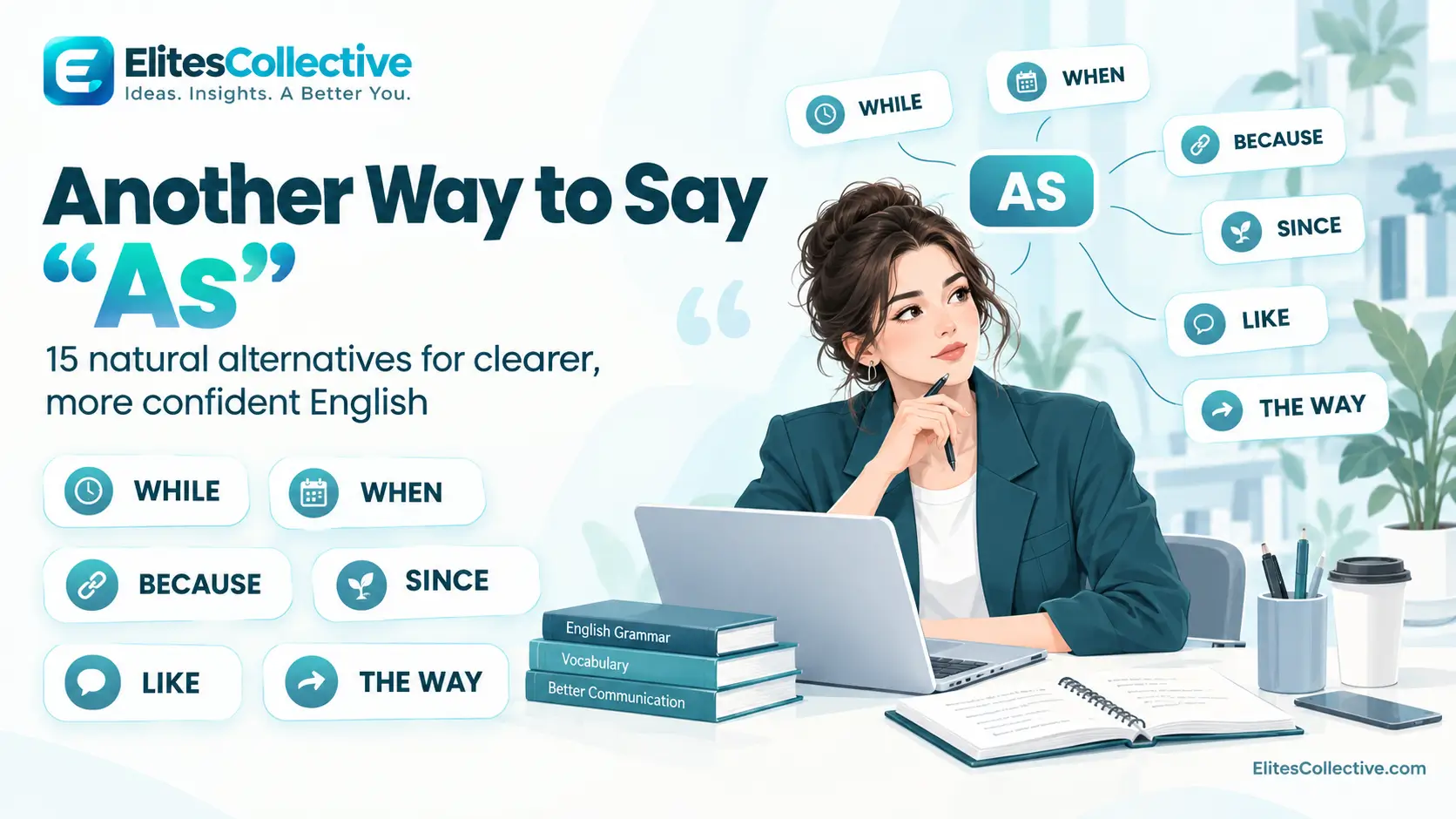
If you need another way to say “as,” the best replacement depends on what “as” means in your sentence. It can show time, reason, similarity, role, or the way something happens. Common alternatives include while, because, since, like, in the way that, when, and because of.
Key Takeaways
- “As” has several meanings, so there is no single replacement that works everywhere.
- Use while or when when “as” refers to two things happening at the same time.
- Use because or since when “as” gives a reason.
- Use like when “as” compares people or things in informal English.
- Use in the way that when “as” describes how something is done.
- In formal writing, the best alternative depends on the exact relationship between the ideas.
What Does “As” Mean?
The word “as” is one of the most flexible words in English. Its meaning changes depending on the sentence.
For example:
- Time: “As I walked home, it started to rain.”
- Reason: “As it was late, we decided to leave.”
- Comparison: “She sings as her mother does.”
- Role: “He works as a teacher.”
- Manner: “Do it as I showed you.”
Because of these different uses, replacing “as” requires attention to the sentence’s meaning. A word that works in one sentence may sound incorrect in another.
15 Alternatives to “As”
1. While
Use while when two actions happen at the same time.
Example:
“As I was cooking, my sister called.”
Alternative:
“While I was cooking, my sister called.”
Best for: Everyday and neutral writing.
While and “as” can often be interchangeable when they describe simultaneous actions. However, “while” can put slightly more emphasis on the duration of the action.
2. When
Use when when one event happens during or around the time of another.
Example:
“As I arrived at the office, the meeting began.”
Alternative:
“When I arrived at the office, the meeting began.”
Best for: Everyday conversation and general writing.
“When” is often clearer than “as” when the sentence describes a specific event rather than two ongoing actions.
3. Because
Use because when “as” means for the reason that.
Example:
“As it was raining, we stayed inside.”
Alternative:
“Because it was raining, we stayed inside.”
Best for: Clear explanations and direct writing.
“Because” is usually stronger and more direct than “as” when giving a reason.
4. Since
Since can replace “as” when it introduces a reason.
Example:
“As you already know the answer, I’ll move on.”
Alternative:
“Since you already know the answer, I’ll move on.”
Best for: Neutral and formal writing.
Be careful with “since,” because it can also refer to time. For example, “I have lived here since 2020” has a completely different meaning.
5. Like
Use like when “as” is being used for an informal comparison.
Example:
“She looks as her mother.”
In standard English, this sentence would normally need a different structure. In many everyday comparisons, like is natural:
“She looks like her mother.”
Best for: Casual and conversational English.
“Like” and “as” are not always interchangeable. “Like” is normally followed by a noun or pronoun when making a direct comparison.
6. In the Way That
Use in the way that when “as” describes how something is done.
Example:
“Please arrange the files as I showed you.”
Alternative:
“Please arrange the files in the way that I showed you.”
Best for: Clear explanations when the manner needs emphasis.
This alternative is longer, so it is usually unnecessary in simple sentences. It can be useful when you want to make the meaning especially clear.
7. The Way
In casual American English, the way can often replace “as” when describing how something happens.
Example:
“Do it as I told you.”
Alternative:
“Do it the way I told you.”
Best for: Conversational English.
“The way” sounds natural and relaxed, especially in speech.
8. Just as
Use just as when you want to emphasize that two things happen in the same way or at the same time.
Example:
“As the sun was setting, we reached the beach.”
Alternative:
“Just as the sun was setting, we reached the beach.”
Best for: Emphasis and descriptive writing.
“Just as” often creates a stronger sense of timing than simple “as.”
9. In the Same Way That
Use in the same way that when comparing how two things happen.
Example:
“She handled the situation as her manager would.”
Alternative:
“She handled the situation in the same way that her manager would.”
Best for: Formal or explanatory writing.
This phrase is more explicit than “as,” but it can sound unnecessarily long in casual sentences.
10. At the Same Time That
Use at the same time that when “as” means that two events happen simultaneously.
Example:
“As the door opened, everyone became quiet.”
Alternative:
“At the same time that the door opened, everyone became quiet.”
Best for: Situations where timing needs to be especially clear.
In most cases, when or while will sound more natural.
11. In My Role As
When “as” describes someone’s position or function, it should not always be replaced with a simple synonym.
Example:
“As a manager, I need to make difficult decisions.”
A natural alternative is:
“In my role as a manager, I need to make difficult decisions.”
Best for: Professional and workplace writing.
Here, “as” means in the capacity of, rather than “because” or “while.”
12. In the Capacity of
Use in the capacity of when “as” identifies an official role or function.
Example:
“She attended the meeting as a company representative.”
Alternative:
“She attended the meeting in the capacity of a company representative.”
Best for: Formal or official writing.
This phrase is much more formal than “as,” so it can sound stiff in everyday conversation.
13. Because of the Fact That
When “as” gives a reason, because of the fact that can sometimes express the same idea.
Example:
“As the store was closed, we went home.”
Alternative:
“Because of the fact that the store was closed, we went home.”
Best for: Very formal contexts, although usually not recommended.
In most cases, simply using because is clearer and more concise.
14. Given That
Use given that when “as” introduces a reason that should be considered in light of the circumstances.
Example:
“As you have already completed the course, you don’t need to take the introductory class.”
Alternative:
“Given that you have already completed the course, you don’t need to take the introductory class.”
Best for: Formal, professional, and analytical writing.
“Given that” can sound more deliberate than “because.”
15. Considering That
Use considering that when the information that follows provides a reason or circumstance that affects the situation.
Example:
“As the weather was so bad, the event was canceled.”
Alternative:
“Considering that the weather was so bad, the event was canceled.”
Best for: Explanatory and conversational writing.
It can suggest that the situation is being evaluated in light of a particular fact.
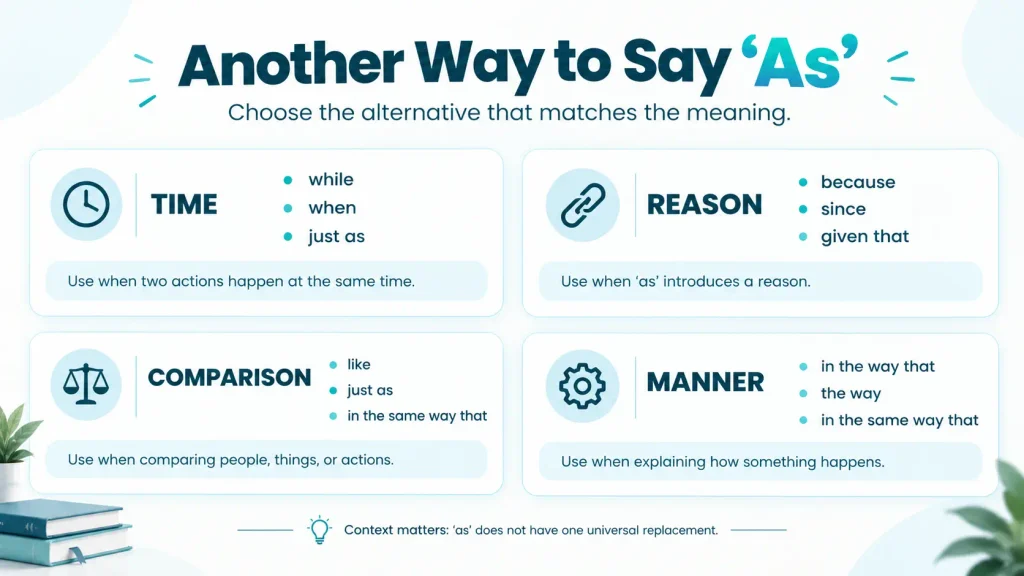
“As” Alternatives by Meaning
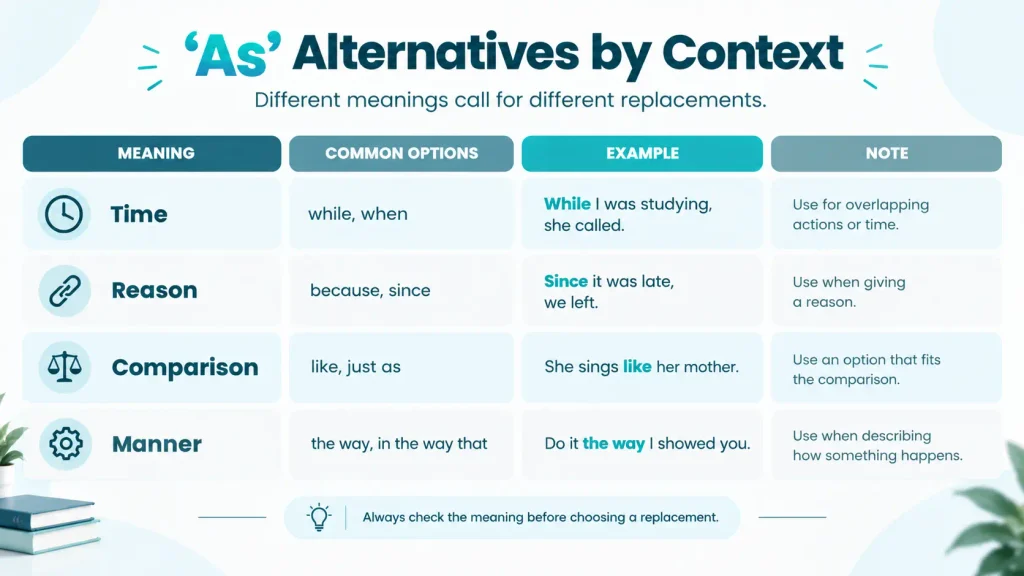
Choosing the right replacement becomes easier when you first identify what “as” means in your sentence.
| Meaning of “as” | Natural Alternative | Example |
| At the same time | while | While I was leaving, she called. |
| At a particular time | when | When I arrived, they started. |
| For the reason that | because | Because it was late, we left. |
| Reason or circumstance | since | Since you’re here, let’s begin. |
| Comparison | like | She looks like her sister. |
| Manner | the way | Do it the way I showed you. |
| Same manner | in the same way that | He works in the same way that I do. |
| Role | in my role as | In my role as manager, I oversee the team. |
| Official function | in the capacity of | She acted in the capacity of an adviser. |
| Reason based on circumstances | given that | Given that it’s late, we should leave. |
| Reason based on circumstances | considering that | Considering that he was tired, he did well. |
How to Choose the Right Alternative
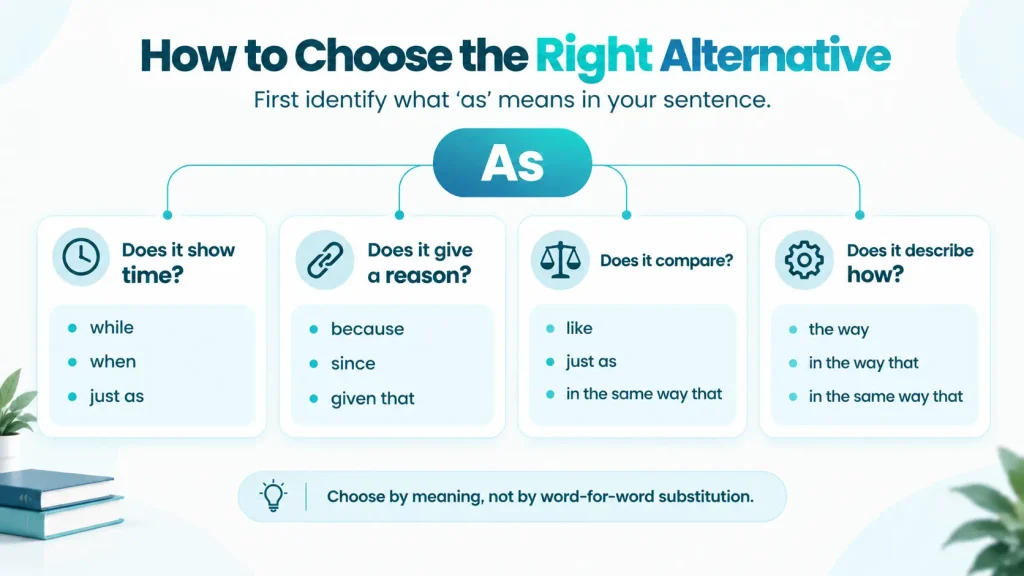
Before replacing “as,” ask what relationship it creates between the two parts of your sentence.
If it means “at the same time”
Choose while or when.
As I walked into the room, everyone stopped talking.
While I walked into the room, everyone stopped talking.
Depending on the exact meaning, when may also work:
When I walked into the room, everyone stopped talking.
If it means “because”
Choose because or since.
As I was feeling sick, I stayed home.
Because I was feeling sick, I stayed home.
“Because” is often the clearest choice when you want to make the reason unmistakable.
If it means “in the same way”
Choose the way, in the way that, or in the same way that.
Do it as I explained.
Do it the way I explained.
The second version sounds especially natural in everyday American English.
If it identifies a role
Keep as, or use a longer phrase such as in my role as or in the capacity of.
She works as a consultant.
In her role as a consultant, she advises several companies.
The best choice depends on whether you want a simple statement or a more formal description.
Common Mistakes With “As” Alternatives
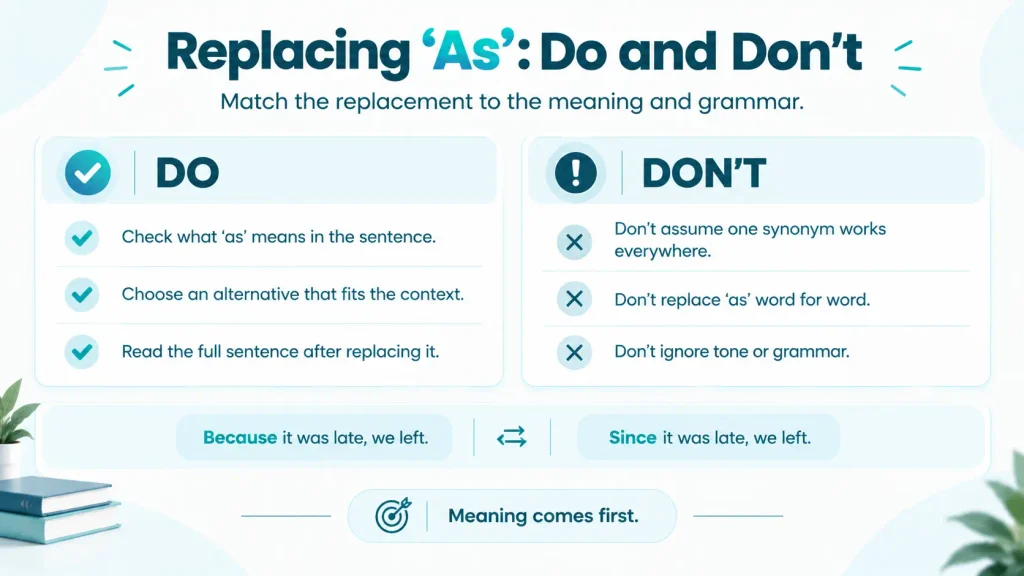
Using “like” in every comparison
“Like” cannot replace “as” in every sentence.
For example:
Do it as I showed you.
The natural alternative is:
Do it the way I showed you.
Not every use of “as” is a direct comparison.
Using “since” when the meaning is unclear
“Since” can mean either because or from a particular time.
Compare:
Since it was raining, we stayed home.
Here, “since” means because.
I have lived here since 2020.
Here, “since” refers to time.
If there could be confusion, because may be the clearer choice.
Making simple sentences too formal
Phrases such as in the capacity of and because of the fact that can be grammatically acceptable but unnecessarily formal.
Instead of:
Because of the fact that the meeting was canceled, we left.
Prefer:
Because the meeting was canceled, we left.
Clear writing is usually better than complicated wording.
Frequently Asked Questions
What is the best alternative to “as”?
There is no single best replacement. While, when, because, since, like, the way, and given that can all replace “as” in specific contexts. The correct choice depends on what “as” means in the sentence.
What is another way to say “as” in a formal sentence?
Depending on the meaning, formal alternatives include given that, considering that, in the capacity of, in my role as, and in the same way that. However, simple words such as because and while are often better even in formal writing.
What is another way to say “as” when giving a reason?
Use because, since, given that, or considering that. For example, “As it was late, we left” can become “Because it was late, we left.”
What can I use instead of “as” for time?
Use when, while, or just as, depending on the sentence. For example, “As I arrived, the meeting started” can become “When I arrived, the meeting started.”
Can “like” replace “as”?
Sometimes, but not always. Like is commonly used for direct comparisons, while as has many other functions. For example, “She looks like her mother” is correct, but “Do it like I showed you” and “Do it as I showed you” can have different grammatical and stylistic considerations.
Is “as” formal or informal?
“As” is a standard word used in both casual and formal English. Its level of formality depends more on the sentence and meaning than on the word itself.
What is another way to say “as” in academic writing?
The best choice depends on meaning. Because, since, while, when, given that, and in the same way that may work in academic writing. Choose the phrase that expresses the exact relationship between the ideas rather than choosing a more complicated word simply to sound formal.
Final Thoughts
“As” is difficult to replace with one universal synonym because it performs several different grammatical and semantic functions. The most natural alternative depends on what you mean: use while or when for time, because or since for reasons, like for certain comparisons, and the way for manner.
The safest approach is to identify the meaning of “as” first and then choose the alternative that preserves that meaning. A simple, natural replacement is usually better than a longer phrase that only sounds more sophisticated

Role: Lead Author & Content Specialist
James Mitchell is an experienced Lead Author at Elite’s Collective. He specializes in creating high-impact editorial content and driving core written projects designed to inform and engage readers.