If you want another way to say “I pride myself,” the most natural alternatives are “I take pride in,” “I’m proud of,” “I value,” “I consider myself strong in,” and “I make it a point to.” However, the standard expression is usually “I pride myself on…”, followed by a quality, skill, or action.
Key Takeaways
- “I pride myself on…” means you feel proud of a quality, skill, or behavior.
- “I take pride in…” is one of the closest alternatives.
- “I’m proud of…” is more direct and conversational.
- “I value…” sounds less self-congratulatory and focuses on what matters to you.
- “I make it a point to…” works well when you want to emphasize a habit or deliberate effort.
- In most cases, “I pride myself on” is more complete and natural than simply “I pride myself.”
What Does “I Pride Myself On” Mean?
The phrase “I pride myself on” means that you consider a particular quality, skill, habit, or ability one of your strengths. Cambridge defines it as valuing a special quality or ability you have, while Oxford gives the simpler meaning “to be proud of something.”
For example:
I pride myself on being reliable.
This means:
I am proud of being reliable.
The expression is often followed by a noun or a verb ending in -ing:
- I pride myself on my honesty.
- I pride myself on being dependable.
- I pride myself on my attention to detail.
- I pride myself on keeping my promises.
Is “I Pride Myself” Correct?
It can appear without the rest of the phrase in certain contexts, but “I pride myself on…” is the standard expression when you want to explain what you are proud of. Major dictionaries list the construction as pride yourself on something/on doing something.
So instead of:
I pride myself being organized.
write:
I pride myself on being organized.
15 Natural Alternatives to “I Pride Myself On”
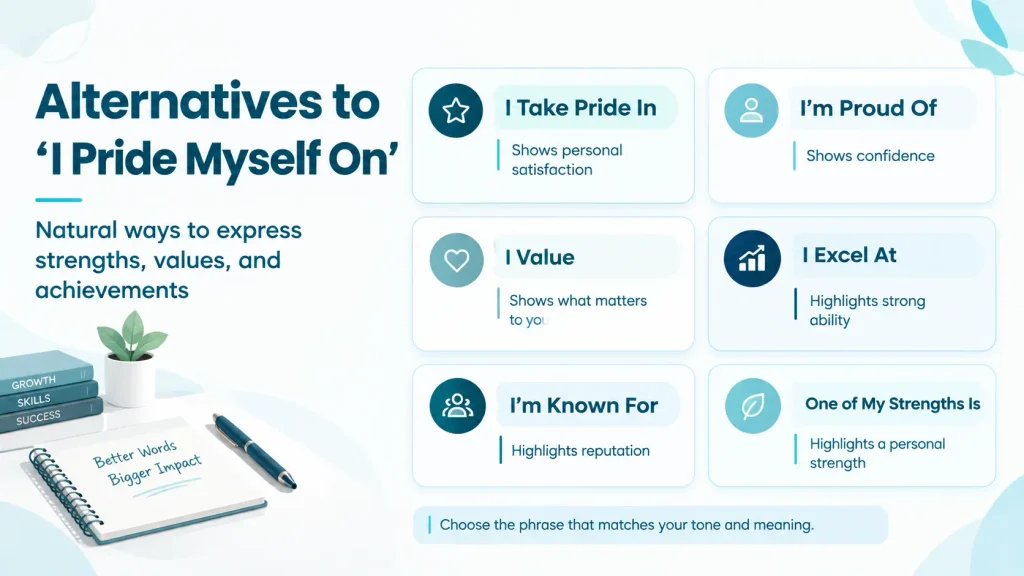
The best replacement depends on how confident, formal, modest, or conversational you want to sound.
1. I Take Pride In
This is probably the closest direct alternative to “I pride myself on.” It expresses satisfaction or pride in something you do or a quality you have.
Example:
I take pride in delivering high-quality work.
Best for: Professional, formal, and neutral writing.
2. I’m Proud Of
This is simpler and more conversational. It works in everyday speech as well as many forms of professional writing.
Example:
I’m proud of the way I handle difficult projects.
Best for: Everyday conversation, personal writing, and straightforward statements.
Tip: This phrase is broader than “I pride myself on.” You can be proud of your own actions, another person, an achievement, or an object.
3. I Value
“I value” focuses more on importance than personal pride. It is useful when you want to sound modest or professional.
Example:
I value honesty and clear communication.
Best for: Professional, academic, and thoughtful writing.
4. I Consider Myself Strong In
Use this when you want to highlight a particular skill without sounding overly proud.
Example:
I consider myself strong in problem-solving and communication.
Best for: Resumes, interviews, professional profiles, and self-descriptions.
5. I’m Known For
This shifts the focus from what you think about yourself to how other people recognize you.
Example:
I’m known for my attention to detail.
Best for: Professional bios, resumes, LinkedIn profiles, and introductions.
6. I’m Particularly Good At
This is a natural way to identify a strength directly.
Example:
I’m particularly good at finding practical solutions to complex problems.
Best for: Interviews, casual conversations, and professional settings.
7. I Excel At
“I excel at” is stronger than “I’m good at.” It suggests a high level of ability.
Example:
I excel at building strong relationships with clients.
Best for: Professional writing, resumes, interviews, and career profiles.
Tip: Because it sounds confident, use it when you can support the claim with real skills or results.
8. I Make It a Point To
This alternative emphasizes deliberate effort rather than pride.
Example:
I make it a point to respond to clients promptly.
Best for: Workplace communication and situations involving habits or standards.
9. I Place Great Importance On
This sounds more formal and emphasizes the importance you give something.
Example:
I place great importance on accuracy and clear communication.
Best for: Formal writing, business communication, and professional statements.
10. I’m Committed To
Use this when you want to emphasize dedication rather than pride.
Example:
I’m committed to providing reliable customer service.
Best for: Professional profiles, company statements, applications, and workplace writing.
11. I Strive To
“I strive to” focuses on continuous effort. It is useful when you are working toward a standard rather than claiming that you have already achieved it perfectly.
Example:
I strive to make every project clear, accurate, and useful.
Best for: Professional and personal statements.
12. I Make a Point of
This is similar to “I make it a point to.” It highlights something you deliberately try to do.
Example:
I make a point of keeping my clients informed throughout each project.
Best for: Conversational and professional English.
13. I Hold Myself to a High Standard
This emphasizes personal expectations and quality.
Example:
I hold myself to a high standard when it comes to my work.
Best for: Interviews, professional profiles, and self-evaluations.
14. I See This as One of My Strengths
This sounds confident without being overly boastful.
Example:
I see attention to detail as one of my strengths.
Best for: Interviews, resumes, cover letters, and professional conversations.
15. One of My Strengths Is
This is a polished way to introduce a personal strength.
Example:
One of my strengths is staying calm under pressure.
Best for: Job interviews, resumes, cover letters, and professional introductions.
Quick Comparison
| Alternative | Main Meaning | Tone | Best Context |
|---|---|---|---|
| I take pride in | Feel proud of something | Neutral | General, professional |
| I’m proud of | Feel pride about something | Conversational | Everyday use |
| I value | Consider something important | Modest | Professional, academic |
| I consider myself strong in | Identify an ability | Professional | Resume, interview |
| I’m known for | Others recognize this quality | Confident | Professional profile |
| I’m particularly good at | Have a strong ability | Neutral | Conversation, work |
| I excel at | Perform very well | Confident | Career, professional |
| I make it a point to | Make a deliberate effort | Practical | Workplace |
| I’m committed to | Show dedication | Professional | Applications, business |
| I strive to | Make continued effort | Positive | Professional, personal |
| I hold myself to a high standard | Expect quality from yourself | Confident | Work, interviews |
| One of my strengths is | Identify a positive quality | Professional | Interviews, resumes |
Which Alternative Should You Use?
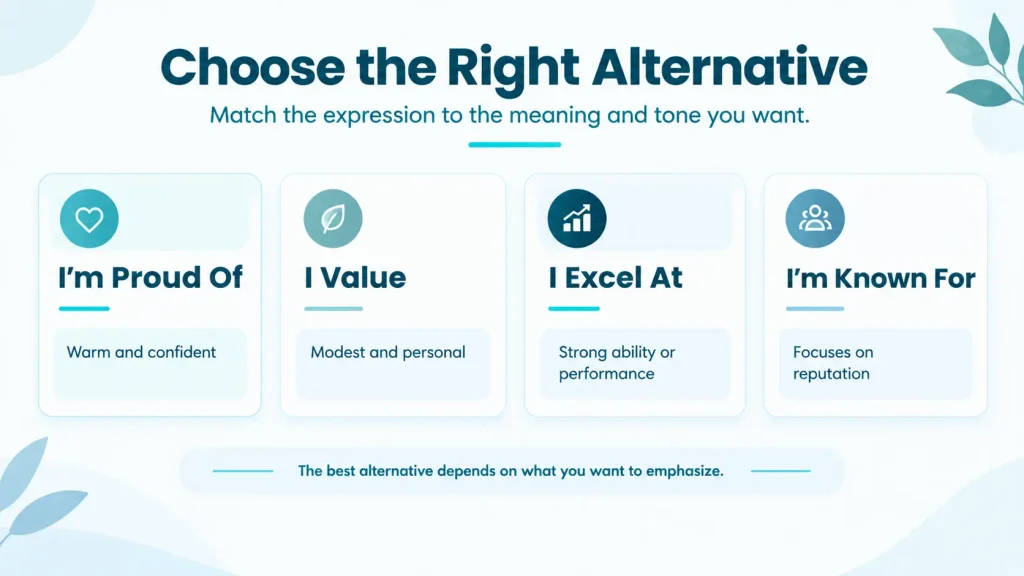
There is no single replacement that works in every sentence. The best choice depends on what you want to emphasize.
To express pride
Use:
- I take pride in
- I’m proud of
Original:
I pride myself on my attention to detail.
Alternative:
I take pride in my attention to detail.
To sound more professional
Use:
- I consider myself strong in
- I excel at
- I’m known for
- One of my strengths is
Original:
I pride myself on solving problems quickly.
Professional:
One of my strengths is solving problems quickly.
To sound more modest
Use:
- I value
- I strive to
- I make it a point to
Original:
I pride myself on being a good listener.
More modest:
I make it a point to listen carefully to others.
To emphasize dedication
Use:
- I’m committed to
- I strive to
- I make it a point to
Original:
I pride myself on providing excellent service.
Alternative:
I’m committed to providing excellent service.
“I Pride Myself On” vs. “I Take Pride In”
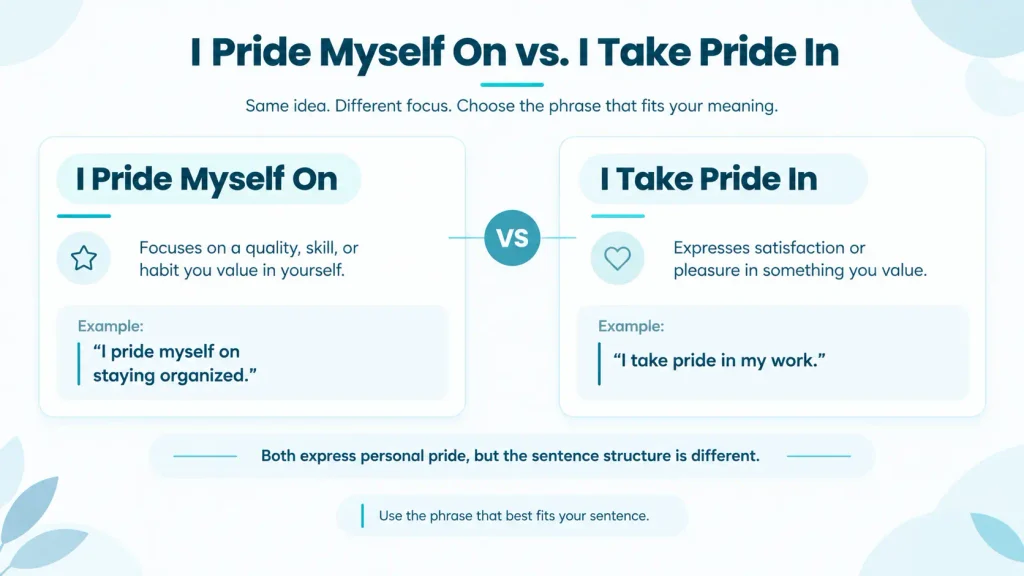
These two expressions are very close, but their grammatical patterns differ.
I pride myself on + noun/gerund
I pride myself on being dependable.
I take pride in + noun/gerund
I take pride in being dependable.
Both communicate a similar idea. The first construction places more attention on your own quality or behavior, while the second focuses more broadly on the thing in which you feel pride.
“I Pride Myself On” vs. “I’m Proud Of”
These expressions are also similar, but “I’m proud of” is more flexible.
I pride myself on being organized.
I’m proud of being organized.
You can also say:
I’m proud of my sister.
But you would not normally say:
I pride myself on my sister.
The expressions are therefore related, but they are not interchangeable in every situation.
“I Pride Myself On” vs. “I Boast About”
Be careful with “boast,” “brag,” and similar expressions. They can suggest that someone talks about their achievements too much.
Compare:
I pride myself on being honest.
This usually sounds positive.
I brag about being honest.
This can sound arrogant or self-important.
So “boast about” is not a neutral replacement when you simply want to express healthy confidence. Collins lists expressions such as “boast of,” “brag about,” and “glory in” among related alternatives, but their tone can be quite different from the neutral “take pride in.”
Common Mistakes
1. Forgetting “on”
Incorrect:
I pride myself being organized.
Correct:
I pride myself on being organized.
The established construction is pride yourself on something/on doing something.
2. Using “in” with “pride myself”
A common mistake is:
I pride myself in my work.
For standard American English, “I pride myself on my work” is the safer and more natural construction. If you want to use in, change the structure:
I take pride in my work.
3. Choosing “brag” when you mean “take pride”
“Brag” suggests talking about yourself in a way that may sound boastful. It is not always a positive substitute.
4. Using “excel at” for something that is a value
“Excel at” describes strong performance or ability.
I excel at analyzing data.
But for a personal value, use:
I value honesty.
5. Making every statement sound overly confident
If you are writing a resume or interview response, repeatedly saying “I excel at…” or “I’m exceptional at…” can sound exaggerated.
Sometimes a more measured phrase is stronger:
One of my strengths is attention to detail.
FAQs About Another Way to Say “I Pride Myself”
What is the best alternative to “I pride myself on”?
“I take pride in” is usually the closest natural alternative. For a simpler tone, “I’m proud of” also works well.
Is “I pride myself” grammatically correct?
It can be used in context, but when you are describing what you are proud of, the standard construction is “I pride myself on…” followed by a noun or an -ing form.
What is a professional way to say “I pride myself on”?
Try “One of my strengths is,” “I excel at,” “I’m known for,” or “I consider myself strong in.” The best option depends on the specific skill or quality.
What is a humble way to say “I pride myself on”?
Use “I value,” “I strive to,” or “I make it a point to.” These phrases emphasize your values or effort rather than directly emphasizing your achievements.
Can I say “I take pride in myself”?
Yes, but it has a slightly different focus. “I take pride in my work” focuses on the work, while “I take pride in myself” focuses more broadly on your sense of self-worth or personal conduct.
Is “I pride myself in” correct?
It is much less standard than “I pride myself on.” For the most natural phrasing, use “I pride myself on” or change the construction to “I take pride in.”
Is “I pride myself on” formal or informal?
It is a neutral expression that works in both everyday and professional English. It can sound slightly more polished than the simple “I’m proud of.”
Final Thoughts
If you want another way to say “I pride myself on,” start with “I take pride in” when you want the closest replacement. Choose “I’m proud of” for a simple, conversational tone, “I value” for a more modest tone, or “one of my strengths is” for professional writing.
The important point is that “I pride myself on” is the standard construction when you want to identify a quality, skill, or behavior that makes you feel proud.

Role: Lead Author & Content Specialist
James Mitchell is an experienced Lead Author at Elite’s Collective. He specializes in creating high-impact editorial content and driving core written projects designed to inform and engage readers.