
Looking for another way to say “on the right track”? Depending on the context, you can say “heading in the right direction,” “on the right path,” “moving in the right direction,” “making progress,” or “on course.” The best choice depends on whether you want to emphasize direction, progress, appropriate actions, or movement toward a specific goal.
Key Takeaways
- “Heading in the right direction” is one of the closest natural alternatives to “on the right track.”
- “On the right path” works well when talking about decisions, personal growth, career development, or long-term goals.
- “Making progress” emphasizes improvement or advancement rather than direction.
- “On course” is concise and works especially well in professional or goal-oriented contexts.
- “Making headway” is useful when you want to emphasize meaningful progress, especially when something is difficult.
- Not every alternative has exactly the same meaning, so context matters when choosing the best expression.
What Does “On the Right Track” Mean?
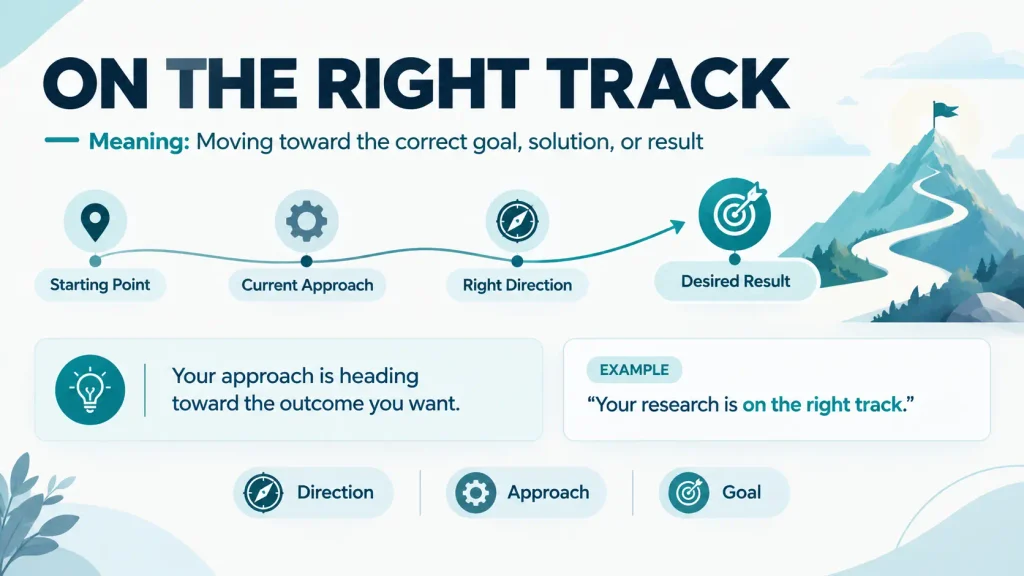
The phrase “on the right track” is an idiom that means someone or something is moving toward the correct goal, solution, result, or outcome.
For example:
Your research is on the right track.
This means the research is heading toward a useful or correct result.
The phrase can describe a person’s actions, a project, an idea, a plan, or progress toward a goal. It is usually positive and encouraging without sounding overly formal.
If you want a different expression, choose one based on what you want to emphasize: direction, progress, correctness, appropriate actions, or successful development.
10 Other Ways to Say “On the Right Track”
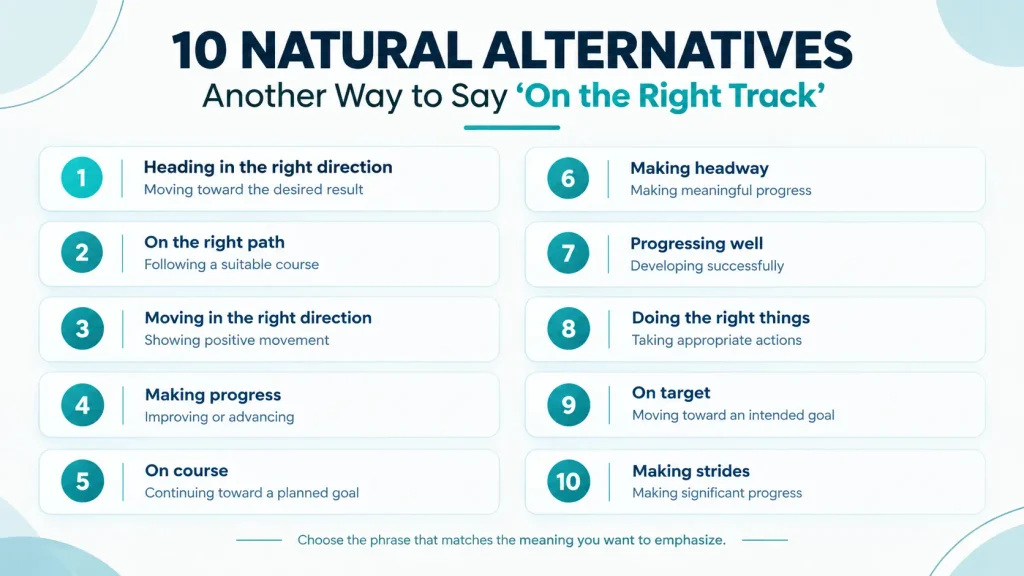
1. Heading in the Right Direction
“Heading in the right direction” is one of the closest natural alternatives to “on the right track.” It emphasizes that someone or something is moving toward the desired result.
Best for: Everyday, professional, academic, and goal-related situations.
Example:
Your business plan is heading in the right direction.
This phrase is especially useful when the final result has not been reached yet, but the current approach looks promising.
2. On the Right Path
“On the right path” suggests that someone is following a suitable approach or making good choices. It can sound slightly more personal or reflective than “on the right track.”
Best for: Personal goals, education, career development, decisions, and long-term progress.
Example:
You’re on the right path to reaching your career goals.
It can also refer to personal development:
She feels like she’s finally on the right path.
3. Moving in the Right Direction
“Moving in the right direction” focuses on positive movement toward a desired outcome. It is useful when you want to acknowledge improvement without suggesting that everything is already correct.
Best for: Projects, plans, businesses, relationships, and personal goals.
Example:
The latest changes are moving the project in the right direction.
This expression can sound slightly more cautious than “you’re on the right track” because it acknowledges positive movement while leaving room for further changes.
4. Making Progress
“Making progress” is a simple and versatile alternative, but it changes the emphasis slightly. Instead of focusing on whether the direction is correct, it focuses on improvement or advancement.
Best for: Work, studying, personal goals, projects, and skill development.
Example:
You’re making good progress with your writing.
Use this when the important point is that someone is getting closer to a goal or improving over time.
5. On Course
“On course” means continuing toward a planned goal, result, or destination. It can sound more professional or goal-oriented than “on the right track.”
Best for: Projects, schedules, business goals, plans, and formal communication.
Example:
The project is on course to meet its deadline.
A related expression, “on course to,” is especially useful when you want to mention a specific expected result.
The company is on course to reach its annual target.
6. Making Headway
“Making headway” means making meaningful progress, especially when something requires effort or has been difficult.
Best for: Difficult projects, problem-solving, research, negotiations, and challenging tasks.
Example:
The team is finally making headway on the problem.
This is not an exact synonym for “on the right track.” It emphasizes progress despite difficulty, rather than simply being headed in the correct direction.
7. Progressing Well
“Progressing well” is a straightforward way to say that something is developing or advancing successfully.
Best for: Projects, assignments, work, learning, and formal or neutral communication.
Example:
The project is progressing well, and we’re still ahead of schedule.
This phrase works particularly well when discussing the current status of something. However, it focuses more on successful development than on whether the overall direction is correct.
8. Doing the Right Things
“Doing the right things” shifts the focus from overall direction to actions and choices. It works when you want to say that someone’s efforts or decisions are appropriate for reaching a goal.
Best for: Personal improvement, business decisions, work, studying, and goal-setting.
Example:
You’re doing the right things to improve your writing skills.
This is not a direct replacement in every sentence. It is better when the context is specifically about actions, choices, or efforts.
9. On Target
“On target” means that something is meeting or moving toward an intended goal, standard, or result. It is particularly useful when discussing measurable objectives or expected outcomes.
Best for: Goals, plans, performance, estimates, deadlines, and professional situations.
Example:
The team is on target to complete the project by Friday.
It can also describe something that is accurate or appropriate:
Your analysis is right on target.
Unlike “on the right track,” “on target” can suggest that the expected goal or result is more clearly defined.
10. Making Strides
“Making strides” means making significant or noticeable progress toward a goal.
Best for: Learning, personal development, business, research, projects, and skill development.
Example:
She’s making great strides in improving her English.
This expression emphasizes strong progress rather than simply being on an appropriate path.
Quick Comparison: Which Alternative Should You Use?
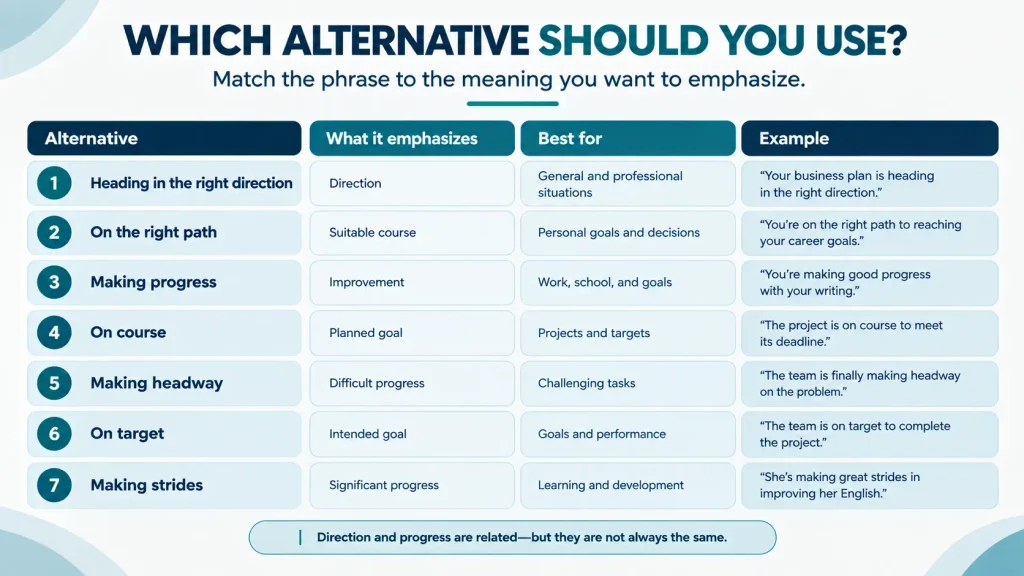
| Alternative | Main Meaning | Tone | Best Context |
| Heading in the right direction | Moving toward the desired result | Neutral | General, professional |
| On the right path | Following a suitable course | Neutral | Personal goals, decisions |
| Moving in the right direction | Showing positive movement | Neutral | Projects, plans |
| Making progress | Improving or advancing | Neutral | Work, school, goals |
| On course | Continuing toward a planned goal | Professional | Projects, targets |
| Making headway | Making meaningful progress | Neutral | Difficult tasks |
| Progressing well | Developing successfully | Neutral/Formal | Work, projects |
| Doing the right things | Taking appropriate actions | Conversational | Goals, decisions |
| On target | Meeting or moving toward an intended goal | Professional | Goals, plans, performance |
| Making strides | Making significant progress | Positive | Learning, development, projects |
“On the Right Track” vs. “Making Progress”
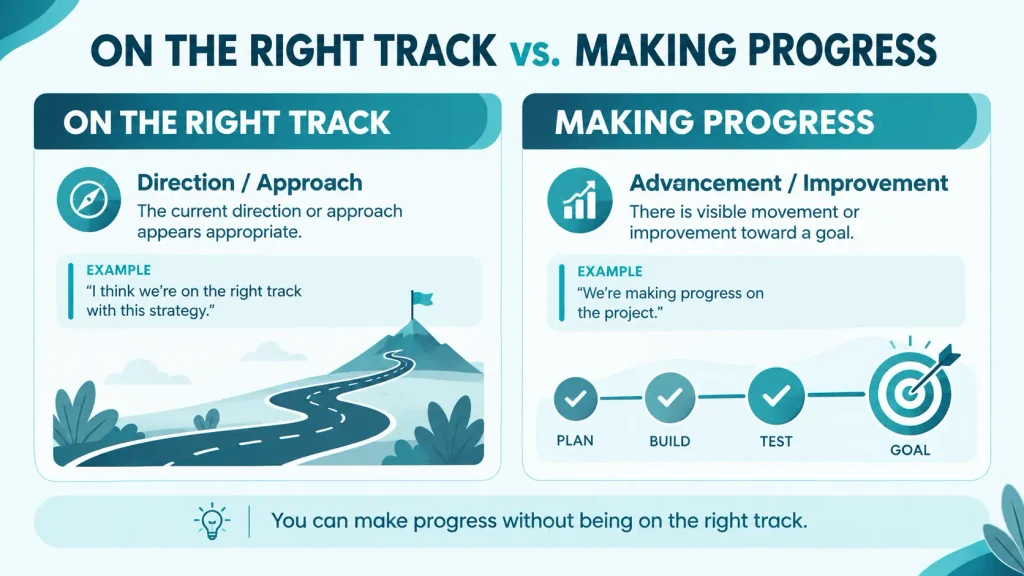
These expressions are related, but they are not identical.
“On the right track” means the approach or direction appears correct.
I think we’re on the right track with this strategy.
“Making progress” means there is visible advancement or improvement.
We’re making progress on the project.
You can be making progress without necessarily being on the right track. For example, someone might complete a lot of work but later discover that the overall approach was wrong.
“On the Right Track” vs. “On the Right Path”
These two expressions are very close, but their typical uses differ slightly.
“On the right track” is common when discussing an idea, solution, project, or approach.
Your solution is on the right track.
“On the right path” often sounds more personal and can refer to someone’s life, career, choices, or development.
She believes she’s on the right path in her career.
Both can express the idea that someone is moving toward a desirable outcome.
How to Choose the Best Alternative
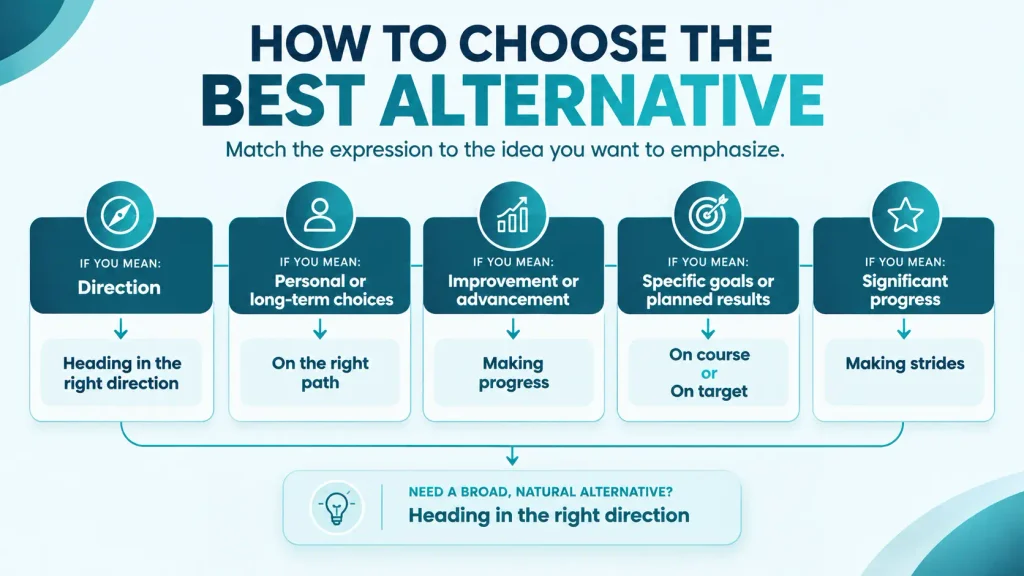
Choose your wording based on what you want to communicate:
- Want to emphasize direction? Use “heading in the right direction.”
- Want to emphasize personal choices? Use “on the right path.”
- Want to emphasize positive movement? Use “moving in the right direction.”
- Want to emphasize improvement? Use “making progress.”
- Want a professional, goal-oriented expression? Try “on course.”
- Want to emphasize difficult progress? Use “making headway.”
- Want to describe successful development? Use “progressing well.”
- Want to praise someone’s actions? Use “doing the right things.”
- Want to emphasize meeting a specific goal or standard? Use “on target.”
- Want to emphasize significant progress? Use “making strides.”
The most natural alternative in many situations is “heading in the right direction.” It preserves the original idea without sounding overly formal or changing the meaning significantly.
Common Mistakes When Replacing “On the Right Track”
Using “Successful” as a Direct Replacement
“Successful” describes an outcome or level of achievement, while “on the right track” describes whether the current approach or direction appears appropriate.
❌ Your plan is successful as a direct replacement for Your plan is on the right track.
✅ Your plan is on the right track.
If the plan has already produced the desired result, “successful” may be appropriate. If it is still developing, “on the right track” is usually more accurate.
Using “Correct” in Every Situation
“Correct” can sound too absolute.
Your answer is correct.
This means the answer is right. It does not necessarily mean that someone is generally moving toward a goal.
For example:
Your approach is on the right track.
suggests that the approach is promising, while:
Your approach is correct.
makes a stronger claim that the approach is right.
Confusing Progress With Direction
“Making progress” and “on the right track” overlap, but they are not interchangeable in every context.
We’re making progress.
This tells the listener that something is advancing.
We’re on the right track.
This tells the listener that the current direction or approach appears appropriate.
Someone can make progress while still using an approach that eventually needs to be changed.
Frequently Asked Questions
What is another way to say “on the right track”?
Natural alternatives include “heading in the right direction,” “on the right path,” “moving in the right direction,” “making progress,” and “on course.” The best choice depends on whether you want to emphasize direction, progress, or a suitable approach.
What is a professional way to say “on the right track”?
For professional writing, “on course,” “progressing well,” “moving in the right direction,” and “on target” can work well. Choose the phrase that matches the specific meaning you want to convey.
What is a more positive way to say “on the right track”?
You can say “making excellent progress,” “making great strides,” “heading in a promising direction,” or “well on the way to achieving the goal.” These expressions add stronger positive emphasis than the original phrase.
Is “on the right path” the same as “on the right track”?
They are very similar, but “on the right path” often has a more personal or long-term feel. “On the right track” is commonly used for projects, ideas, solutions, and approaches.
What is the opposite of “on the right track”?
Depending on the context, you can say “off track,” “heading in the wrong direction,” “on the wrong path,” or “going in the wrong direction.” These expressions indicate that someone or something is not progressing toward the desired result.
Can I use “making progress” instead of “on the right track”?
Sometimes. “Making progress” emphasizes advancement, while “on the right track” emphasizes that the current direction or approach is appropriate. Use “making progress” when improvement or advancement is the main point.
Is “on course” formal?
“On course” can sound somewhat more professional or goal-oriented than “on the right track,” especially when discussing projects, schedules, targets, or plans. It is still natural in standard American English.
Final Thoughts
There are several natural ways to replace “on the right track,” but the best choice depends on the meaning you want to preserve. “Heading in the right direction” is the closest general alternative, while “on the right path” works well for personal or long-term goals. For progress, choose “making progress” or “making strides,” and for professional goals or schedules, “on course” or “on target” can be strong options.
The key is not simply to find a phrase that sounds similar. Choose the expression that accurately communicates whether you mean the right direction, meaningful progress, appropriate actions, successful development, or movement toward a specific goal.

Role: Lead Author & Content Specialist
James Mitchell is an experienced Lead Author at Elite’s Collective. He specializes in creating high-impact editorial content and driving core written projects designed to inform and engage readers.