

Looking for another way to say “throw up”? Whether you are writing a story, describing how someone feels, talking about an illness, or looking for a more polite expression, several alternatives can help you communicate naturally.
Common synonyms for “throw up” include vomit, be sick, get sick, bring up, regurgitate, and retch. However, these expressions have slightly different meanings. For example, “vomit” is a direct and medically appropriate term, while “be sick” is a common expression in everyday English, particularly in British English.
In this guide, you will discover more than 30 alternatives to “throw up,” learn when to use each expression, and explore examples for everyday conversations, professional writing, and informal situations.
Quick Answer: What Is Another Way to Say Throw Up?
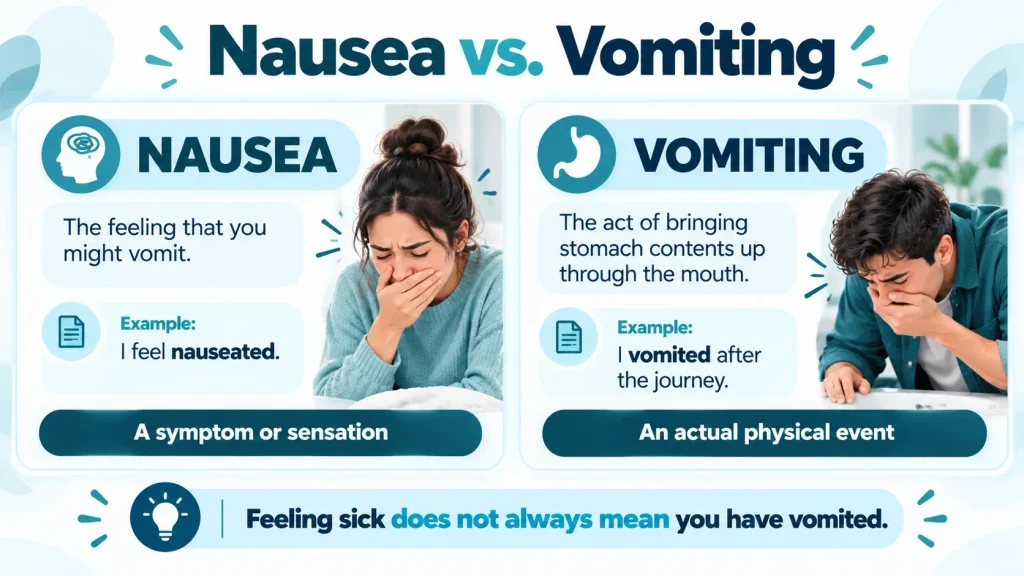
Here are some common alternatives to “throw up”:
- Vomit
- Be sick
- Get sick
- Regurgitate
- Bring up
- Feel nauseated
- Retch
- Heave
- Puke
- Hurl
- Toss your cookies
- Lose your lunch
- Get sick to your stomach
- Bring something back up
- Empty your stomach
- Experience vomiting
- Become ill
- Have an upset stomach
- Be nauseous
- Throw one’s guts up
- Upchuck
- Spew
- Barf
- Feel like vomiting
- Bring up your food
Best overall alternative: “Vomit” is the clearest direct synonym for “throw up.” For polite everyday conversation, “feel sick” or “be sick” may be more appropriate, depending on what you mean.
Best Synonyms for Throw Up With Examples
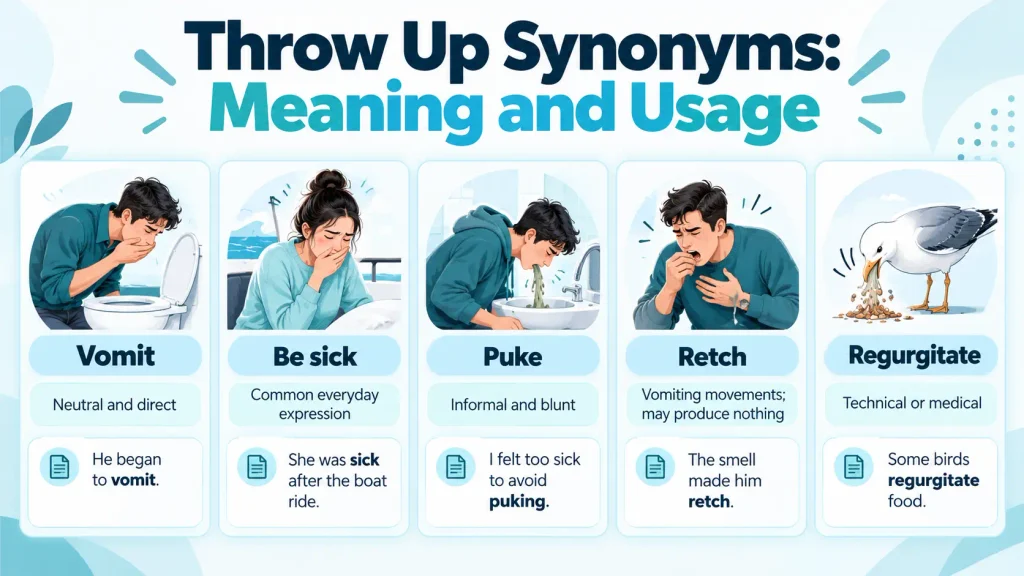
The following table explains common alternatives and shows how to use them in a sentence.
| Alternative | Meaning or Tone | Example |
|---|---|---|
| Vomit | Neutral and direct | He began to vomit after feeling unwell. |
| Be sick | Common everyday expression | She was sick after the long journey. |
| Get sick | Informal and general | I felt dizzy and got sick. |
| Regurgitate | Technical or medical | Some animals regurgitate food to feed their young. |
| Bring up | Indirect and conversational | He brought up his dinner shortly afterward. |
| Retch | Make vomiting movements, sometimes without producing vomit | She began to retch at the unpleasant smell. |
| Heave | Make forceful vomiting movements | He started to heave after becoming nauseated. |
| Puke | Informal and blunt | The child felt so ill that he had to puke. |
| Hurl | Informal and forceful | She thought she might hurl during the boat ride. |
| Toss your cookies | Humorous idiom | He thought the spinning ride would make him toss his cookies. |
| Lose your lunch | Informal idiom | The rough boat ride nearly made me lose my lunch. |
| Upchuck | Informal and often humorous | The child said he might upchuck after the roller coaster. |
| Barf | Informal and blunt | I thought I was going to barf. |
| Spew | Expel something forcefully | The character began to spew after swallowing the bitter liquid. |
| Feel nauseated | Describe the feeling before vomiting | I felt nauseated after the bus ride. |
1. Vomit
“Vomit” is one of the most accurate and widely understood alternatives to “throw up.” It describes the act of expelling stomach contents through the mouth.
Examples:
- Original: I think I am going to throw up.
- Alternative: I think I am going to vomit.
- Original: The child threw up after eating spoiled food.
- Alternative: The child vomited after eating spoiled food.
Best for: Medical descriptions, general writing, educational articles, and situations where clarity matters.
2. Be Sick
“Be sick” is a common expression for vomiting, especially in British English. However, depending on the context, it can also mean being generally unwell.
Examples:
- She was sick after the boat ride.
- The child was sick during the night.
Best for: Everyday conversation, polite descriptions, and informal storytelling.
In American English, “throw up” and “vomit” are generally more explicit when you specifically mean vomiting.
3. Get Sick
“Get sick” can describe becoming ill or experiencing vomiting. The exact meaning depends on the surrounding sentence.
Examples:
- I got sick after the amusement park ride.
- He gets sick whenever he travels on winding mountain roads.
Best for: Everyday conversation and informal writing.
If you want to make it clear that vomiting occurred, use “threw up” or “vomited” instead.
4. Regurgitate
“Regurgitate” is a more technical term that describes bringing swallowed food or liquid back up from the stomach or esophagus. In some contexts, it refers to material returning without the forceful action associated with vomiting.
Examples:
- The patient reported that food sometimes came back up after meals.
- Some birds regurgitate food to feed their young.
Best for: Medical discussions, scientific writing, and explanations of animal behavior.
Although related to vomiting, regurgitation is not always the same process.
5. Bring Up
“Bring up” is a conversational expression that can describe vomiting without using a blunt word.
Examples:
- He brought up his breakfast shortly after eating.
- She felt nauseated and brought up some of her food.
Best for: Everyday conversation, personal stories, and informal writing.
6. Retch
“Retch” means to make the movements associated with vomiting, sometimes without actually bringing anything up.
Examples:
- The unpleasant smell made him retch.
- She continued to retch even after her stomach was empty.
Best for: Descriptive writing, fiction, and medical explanations.
Remember that retching does not necessarily mean that a person has vomited.
7. Heave
“Heave” can describe the forceful movements of the body during an attempt to vomit.
Examples:
- He began to heave after feeling extremely nauseated.
- She leaned over the sink and heaved.
Best for: Storytelling, descriptive passages, and informal descriptions of illness.
8. Puke
“Puke” is an informal and often blunt synonym for “throw up.” It is common in casual American English but may sound inappropriate in formal or professional settings.
Examples:
- I felt so sick that I thought I might puke.
- The child puked after the car ride.
Best for: Casual conversations, informal dialogue, and humorous writing.
9. Hurl
“Hurl” is an informal expression for vomiting. It often conveys a strong or sudden feeling of nausea.
Examples:
- The spinning ride made me feel like I was going to hurl.
- He thought he might hurl after the rough flight.
Best for: Casual American English, storytelling, and informal conversations.
10. Toss Your Cookies
“Toss your cookies” is a humorous American idiom meaning to vomit.
Examples:
- The roller coaster made him feel like he was going to toss his cookies.
- I nearly tossed my cookies during the turbulent flight.
Best for: Informal conversations, comedy, and lighthearted storytelling.
Avoid this expression in medical documents or serious situations.
More Ways to Say Throw Up
Here are additional alternatives, including slang, descriptive expressions, and phrases that communicate related symptoms.
11. Lose Your Lunch
This informal idiom means to vomit.
Example: “The rough boat ride made him feel as though he might lose his lunch.”
12. Upchuck
“Upchuck” is an informal, often humorous word for vomiting.
Example: “He thought he might upchuck after the spinning ride.”
13. Barf
“Barf” is a casual and sometimes crude synonym for “throw up.”
Example: “I felt so nauseated that I thought I would barf.”
14. Spew
“Spew” means to expel something forcefully. It can describe vomiting, but it is also used for liquids, smoke, and other substances.
Example: “The character began to spew after becoming violently ill.”
15. Feel Sick to Your Stomach
This phrase describes nausea and the possibility of vomiting, rather than confirming that vomiting occurred.
Example: “I felt sick to my stomach during the long drive.”
16. Bring Something Back Up
This is a relatively gentle expression for food or liquid returning through the mouth.
Example: “She was worried that she might bring her food back up.”
17. Experience Vomiting
This neutral, formal phrase is suitable for describing a symptom.
Example: “The patient began experiencing vomiting during the night.”
18. Empty Your Stomach
This expression can refer to vomiting, although it may sound indirect or descriptive rather than medical.
Example: “He felt as though he needed to empty his stomach.”
19. Have an Upset Stomach
This phrase describes stomach discomfort and does not necessarily mean vomiting.
Example: “I have an upset stomach after eating too quickly.”
20. Be Nauseous
“Be nauseous” describes feeling sick to the stomach. It does not necessarily mean that vomiting has occurred.
Example: “She felt nauseous during the bus ride.”
21. Feel Like Vomiting
Use this phrase when someone feels that they might vomit.
Example: “I feel like vomiting whenever I read in a moving car.”
22. Throw Your Guts Up
This is an exaggerated, informal expression that suggests severe or repeated vomiting.
Example: “He felt as though he had thrown his guts up after the terrible stomach bug.”
Use it only in casual conversation or expressive storytelling.
23. Bring Up Your Food
This expression describes food coming back up after eating.
Example: “He brought up his food shortly after dinner.”
24. Become Ill
“Become ill” is a broader expression for becoming sick. It does not necessarily mean vomiting.
Example: “She became ill during the trip and had to rest.”
25. Feel Queasy
“Queasy” describes an unsettled stomach or a feeling that you might vomit.
Example: “The winding road made me feel queasy.”
26. Feel Green Around the Gills
This informal idiom describes someone who looks or feels sick.
Example: “After the boat ride, he looked green around the gills.”
27. Be Green Around the Gills
This expression is another way to describe someone who appears nauseated or unwell.
Example: “She was green around the gills after the amusement park ride.”
28. Have a Wave of Nausea
This phrase describes a sudden episode of feeling sick.
Example: “A wave of nausea came over him while he was traveling.”
29. Experience Nausea
This is a neutral and formal way to describe the feeling that often precedes vomiting.
Example: “Some passengers experienced nausea during the flight.”
30. Feel the Urge to Vomit
This expression describes the sensation that vomiting may happen soon.
Example: “I felt the urge to vomit after the sudden movement.”
How to Choose the Right Alternative
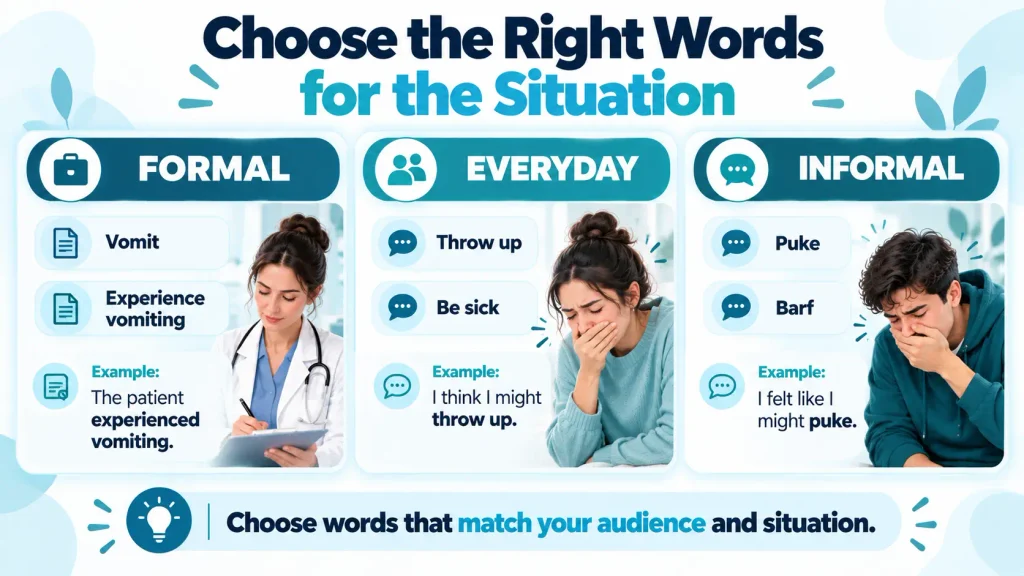
The best alternative depends on your audience, the situation, and whether you are describing actual vomiting or simply feeling sick.
| Situation | Recommended Expression |
|---|---|
| Medical or formal writing | Vomit, experience vomiting |
| Everyday American English | Throw up, vomit |
| Everyday British English | Be sick |
| Casual conversation | Puke, barf |
| Humorous storytelling | Toss your cookies, lose your lunch |
| Descriptive fiction | Retch, heave |
| Feeling sick without vomiting | Feel nauseated, feel queasy |
| Food returning to the mouth | Bring up, regurgitate |
| Polite conversation | Feel sick, be unwell |
Example: Choosing the Best Phrase
Consider this sentence:
“I think I am going to throw up.”
Depending on the situation, you could rewrite it in several ways:
- Neutral: I think I am going to vomit.
- Polite: I think I am going to be sick.
- Informal: I think I am going to puke.
- Descriptive: I feel as though I might retch.
- Focused on the symptom: I feel extremely nauseated.
Each alternative communicates a slightly different tone. Therefore, choose the expression that best fits your audience and intended meaning.
Common Mistakes When Using Synonyms for Throw Up
Confusing Nausea With Vomiting
Nausea is the feeling that you might vomit, whereas vomiting is the actual expulsion of stomach contents.
For example, “I feel nauseated” does not necessarily mean “I threw up.”
Using Slang in Formal Writing
Words such as “puke,” “barf,” and “upchuck” are generally too informal for professional reports or medical documents.
In formal writing, “vomit” or “experience vomiting” is usually more appropriate.
Treating Retching and Vomiting as Identical
Retching involves the movements associated with vomiting, but it may happen without anything coming up.
Choose the correct word to describe what actually happened.
Assuming Every Expression Works in Every English-Speaking Country
Expressions differ by region. For example, “be sick” commonly means vomit in British English, while Americans may interpret it more broadly as being unwell.
Consider your audience when selecting an alternative.
Frequently Asked Questions
What is the most professional way to say throw up?
“Vomit” is a clear, neutral term suitable for most professional and medical contexts. “Experience vomiting” is another appropriate option when describing a symptom in a formal report.
What is a polite way to say throw up?
You can say “feel sick,” “be sick,” or “become unwell,” depending on the context. If you need to be precise, “I feel like I might vomit” communicates the situation clearly without sounding crude.
What is another word for throw up in American slang?
Common informal American expressions include “puke,” “barf,” “hurl,” “upchuck,” and “toss your cookies.” These vary in tone and may sound humorous, blunt, or unpleasant.
Is vomiting the same as throwing up?
Yes. “Vomiting” is the more formal term for “throwing up.” Both describe the expulsion of stomach contents through the mouth.
What is the difference between nausea and vomiting?
Nausea is the uncomfortable feeling that you might vomit. Vomiting is the actual act of bringing stomach contents up through the mouth. A person can experience nausea without vomiting.
What does “toss your cookies” mean?
“Toss your cookies” is an informal American idiom meaning to vomit. It is generally used in casual conversations or humorous situations.
What does “retch” mean?
“Retch” means to make the physical movements associated with vomiting, sometimes without expelling any stomach contents. It is particularly useful in descriptive writing.
What is another way to say “I feel like throwing up”?
You can say “I feel nauseated,” “I feel queasy,” “I think I might vomit,” or “I feel sick to my stomach.” Each expression describes the feeling that vomiting may occur.
Conclusion
Finding another way to say “throw up” can help you communicate more naturally in everyday conversations, creative writing, and professional documents. The best alternative depends on the tone you want and the specific situation you are describing.
Use “vomit” for a clear, neutral expression, “be sick” for a common everyday alternative, and “puke” or “barf” for informal conversation. Meanwhile, “retch” describes the physical act of trying to vomit, while “feel nauseated” communicates the sensation that may come before it.
Ultimately, choosing the right word will make your writing more accurate, natural, and appropriate for your audience.

Role: Author & Editorial Specialist
Sophia Williams serves as an Author at Elite’s Collective, bringing strong communication skills and fresh perspectives to the team through high-quality written content.