

“Make up for” means to compensate for something missing, wrong, lost, or disappointing. Depending on the context, you can say compensate for, make amends for, make it up to, offset, make up the difference, or make good on. The best alternative depends on whether you’re correcting a mistake, balancing a loss, or making someone feel better.
Key Takeaways
- Compensate for works well in formal and professional situations.
- Make amends for is best for correcting a mistake or hurtful action.
- Make it up to someone expresses a personal effort to make things right.
- Offset describes balancing a cost, loss, or disadvantage.
- Make up the difference means covering a gap between two amounts.
- Not every alternative fits every situation, so choose one that matches your intended meaning.
What Does “Make Up for” Mean?
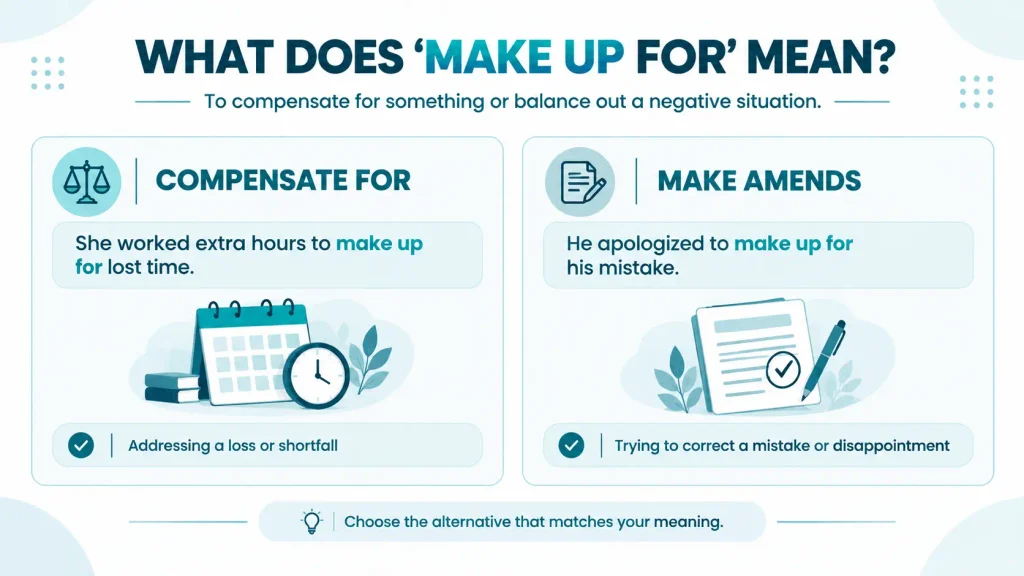
The phrase “make up for” has several related meanings. It can mean compensating for a disadvantage, correcting a mistake, or doing something positive to balance a negative experience.
For example:
- Compensate for a loss: The extra income helped make up for the lost wages.
- Correct a mistake: He bought her flowers to make up for forgetting her birthday.
- Balance a weakness: Her strong communication skills make up for her lack of experience.
The phrase is common in everyday American English, but alternatives can make your writing more precise.
15 Other Ways to Say “Make Up for”
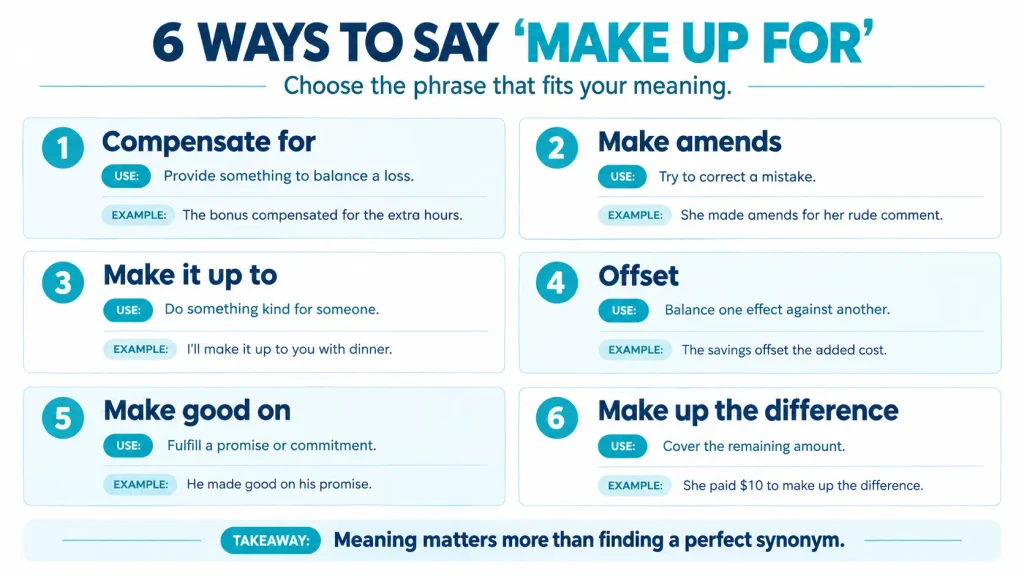
1. Compensate For
Best for: Professional, formal, and financial contexts.
“Compensate for” means to balance a loss, disadvantage, or shortcoming by providing something that helps offset it.
Example: The company offered a bonus to compensate for the extra hours employees worked.
This is one of the closest formal alternatives to “make up for,” especially in business writing.
2. Make Amends For
Best for: Apologies, personal mistakes, and damaged relationships.
“Make amends for” means taking action to correct a wrong or repair the harm caused by your behavior.
Example: He apologized and tried to make amends for his rude comments.
Unlike “compensate for,” this expression often involves accepting responsibility for a mistake.
3. Make It Up To
Best for: Friends, family, relationships, and casual conversations.
“Make it up to” someone means doing something kind or helpful to make up for disappointing or hurting them.
Example: I missed your graduation, but I’ll make it up to you by taking you out to dinner.
Use this expression when the goal is to improve someone’s experience or restore goodwill.
4. Offset
Best for: Business, finance, costs, and measurable disadvantages.
“Offset” means to balance the effect of something negative with something positive.
Example: The money saved on rent helped offset the higher utility bills.
It sounds more analytical than “make up for” and is especially useful when discussing numbers, costs, or competing effects.
5. Make Up the Difference
Best for: Money, budgets, quantities, and shortfalls.
This phrase means providing the amount needed to close a gap between what is available and what is required.
Example: My savings cover most of the cost, and my parents will make up the difference.
Use it when a specific gap needs to be filled rather than when you simply want to correct a mistake.
6. Make Good On
Best for: Promises, commitments, and obligations.
“Make good on” means fulfilling a promise or meeting an obligation, often after a delay or failure to follow through.
Example: The contractor made good on his promise to repair the damaged floor.
This expression is not a universal synonym for “make up for.” It works when the situation involves a promise or commitment.
7. Atone For
Best for: Serious mistakes, wrongdoing, and moral responsibility.
“Atone for” means trying to make up for a wrong or offense, often by accepting responsibility or taking corrective action.
Example: He spent years trying to atone for the harm he had caused.
It carries a stronger moral tone than “make up for” and may sound too serious for minor mistakes.
8. Rectify
Best for: Professional, technical, and formal situations.
“Rectify” means correcting a problem, error, or undesirable situation.
Example: The accounting team worked quickly to rectify the billing error.
Unlike “compensate for,” rectifying a problem focuses on fixing it directly rather than balancing its effects.
9. Make Up for Lost Time
Best for: Work, studying, progress, and personal goals.
This expression means working faster or doing more to recover time that was wasted or unavailable.
Example: After recovering from her illness, Maya worked hard to make up for lost time.
It is a specific expression, not a general replacement for every use of “make up for.”
10. Counterbalance
Best for: Formal writing, analysis, and contrasting effects.
“Counterbalance” means to balance one factor with another that has an opposing effect.
Example: The flexible schedule helped counterbalance the long commute.
This alternative emphasizes two opposing factors rather than an effort to repair a mistake.
11. Cover
Best for: Expenses, shortages, and practical needs.
“Cover” means providing enough money, resources, or support to meet a need or shortfall.
Example: I’ll cover the remaining expenses to make up for the unexpected fee.
Although useful in financial contexts, “cover” does not always convey the idea of repairing a disappointment or wrongdoing.
12. Remedy
Best for: Problems, mistakes, and formal communication.
“Remedy” means correcting a problem or taking steps to improve a bad situation.
Example: The manager introduced a new process to remedy the delays.
Use “remedy” when the focus is on solving the underlying problem, not simply balancing its effects.
13. Make Up for a Shortfall
Best for: Budgets, sales targets, supplies, and resources.
This phrase means providing what is missing to reach a required amount or goal.
Example: Additional sales helped the store make up for the shortfall in its quarterly revenue.
It is particularly useful in business and financial writing.
14. Repay
Best for: Debts, favors, kindness, and obligations.
“Repay” means returning money or responding to someone’s help or kindness with something in return.
Example: She helped me when I needed it, and I hope to repay her kindness someday.
“Repay” can overlap with “make up for” when returning a favor, but it does not fit every kind of loss or mistake.
15. Balance Out
Best for: Everyday conversation and situations involving mixed results.
“Balance out” means that opposing factors offset one another, making the overall result more even.
Example: The higher salary and longer commute balance out in the end.
This is a natural conversational alternative when discussing advantages and disadvantages. It does not necessarily suggest that someone is deliberately correcting a mistake.
Comparison Table: Which Alternative Should You Use?
| Alternative | Main meaning | Best context |
|---|---|---|
| Compensate for | Balance a loss or disadvantage | Professional, financial |
| Make amends for | Repair harm caused by a mistake | Personal, emotional |
| Make it up to | Make someone feel better after disappointment | Casual, relationships |
| Offset | Balance a negative effect | Business, analytical |
| Make up the difference | Fill a gap in an amount | Money, budgets |
| Make good on | Fulfill a promise | Work, commitments |
| Atone for | Seek to address wrongdoing | Serious, moral |
| Rectify | Correct a problem | Formal, technical |
| Counterbalance | Balance opposing effects | Analytical, formal |
| Cover | Provide what is needed | Financial, practical |
How to Choose the Right Phrase
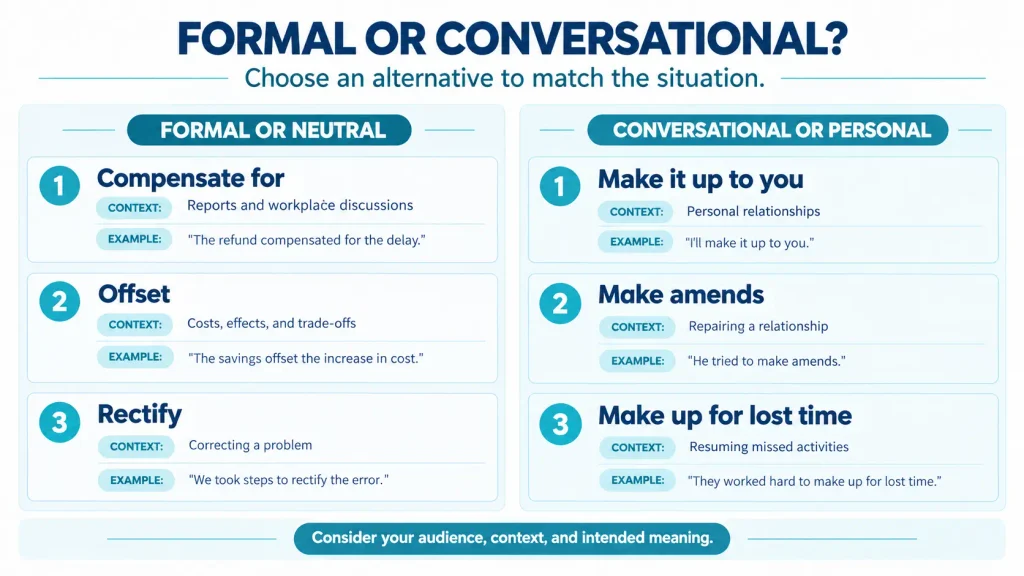
The best replacement depends on what you’re trying to express.
- For a mistake: “I want to make amends for what I said.”
- For disappointing someone: “I’ll make it up to you.”
- For a financial loss: “The refund will compensate for the loss.”
- For a business expense: “The savings will offset the additional cost.”
- For a broken promise: “We need to make good on our commitment.”
- For correcting an error: “We’ll rectify the problem.”
- For recovering lost time: “I’ll work extra hours to make up for lost time.”
A useful rule is to choose “compensate for” when balancing a loss, “make amends for” when repairing harm, and “make it up to” when trying to restore a personal relationship.
Common Mistakes to Avoid
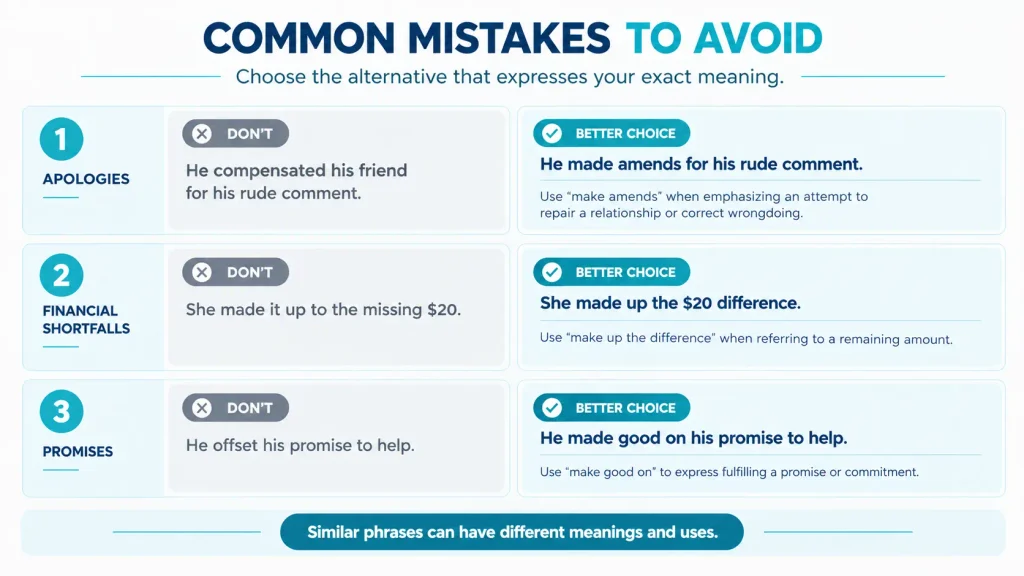
Using “Make Amends For” for Every Situation
“Make amends for” usually suggests wrongdoing or harm. It sounds unnatural when discussing a simple financial shortfall.
- Awkward: The extra revenue made amends for the budget shortfall.
- Better: The extra revenue offset the budget shortfall.
Confusing “Make It Up To” With “Make Up For”
“Make it up to” usually takes a person as its object.
- Natural: I’ll make it up to Sarah.
- Natural: I’ll make up for the delay.
The first focuses on Sarah; the second focuses on the delay.
Using “Rectify” When You Mean Compensation
Rectifying a problem means fixing it. Compensating for a problem means balancing its effects.
For example, correcting an incorrect invoice rectifies the error, while refunding an overcharge compensates the customer for the amount paid.
Frequently Asked Questions
What is the most formal way to say “make up for”?
“Compensate for” is one of the most useful formal alternatives. For example, “The additional payment will compensate for the inconvenience.”
What is another way to say “make up for a mistake”?
You can say “make amends for a mistake,” “correct the mistake,” or “take steps to remedy the mistake.” Use “make amends” when responsibility and repairing harm are important.
What is a casual way to say “make up for”?
“Make it up to you” is a natural choice when speaking to a friend or family member. For example, “Sorry I canceled our plans. I’ll make it up to you this weekend.”
What is another way to say “make up for lost time”?
You can say “catch up,” “regain lost ground,” or “work to recover lost time,” depending on the situation. “Catch up” is especially natural when you need to complete missed work or reach the same progress level as others.
Is “compensate for” the same as “make up for”?
They often have similar meanings, especially when discussing losses or disadvantages. However, “compensate for” sounds more formal and often emphasizes balancing a negative effect, while “make up for” is more flexible in everyday speech.
What is another way to say “make up for someone”?
The right phrase depends on the intended meaning. If you mean doing something nice after disappointing a person, say “make it up to someone.” If you mean taking another person’s place, use “fill in for someone” or “substitute for someone.” These expressions describe different situations.
Can I use “offset” instead of “make up for”?
Yes, when you mean balancing a negative effect, cost, or disadvantage. For example, “The tax credit helped offset the increase in expenses.” It is less suitable for expressing an apology or repairing a personal relationship.
Conclusion
The best alternative to “make up for” depends on the situation. Use “compensate for” for losses, “make amends for” for wrongdoing, “make it up to” someone after a disappointment, and “offset” when balancing costs or disadvantages. Choosing the phrase that matches your meaning will make your American English clearer and more natural.

Role: Author & Contributing Writer
Olivia Bennett is a dedicated Author at Elite’s Collective, focused on delivering clear, well-researched, and engaging articles tailored to the audience.